Direct vs Grey Route SMS in India: OTP Delivery Guide
Confused by cheap Indian SMS rates? Learn what grey routes are, how they bypass DLT rules, and how to verify if your provider uses Tier-1 direct connections.
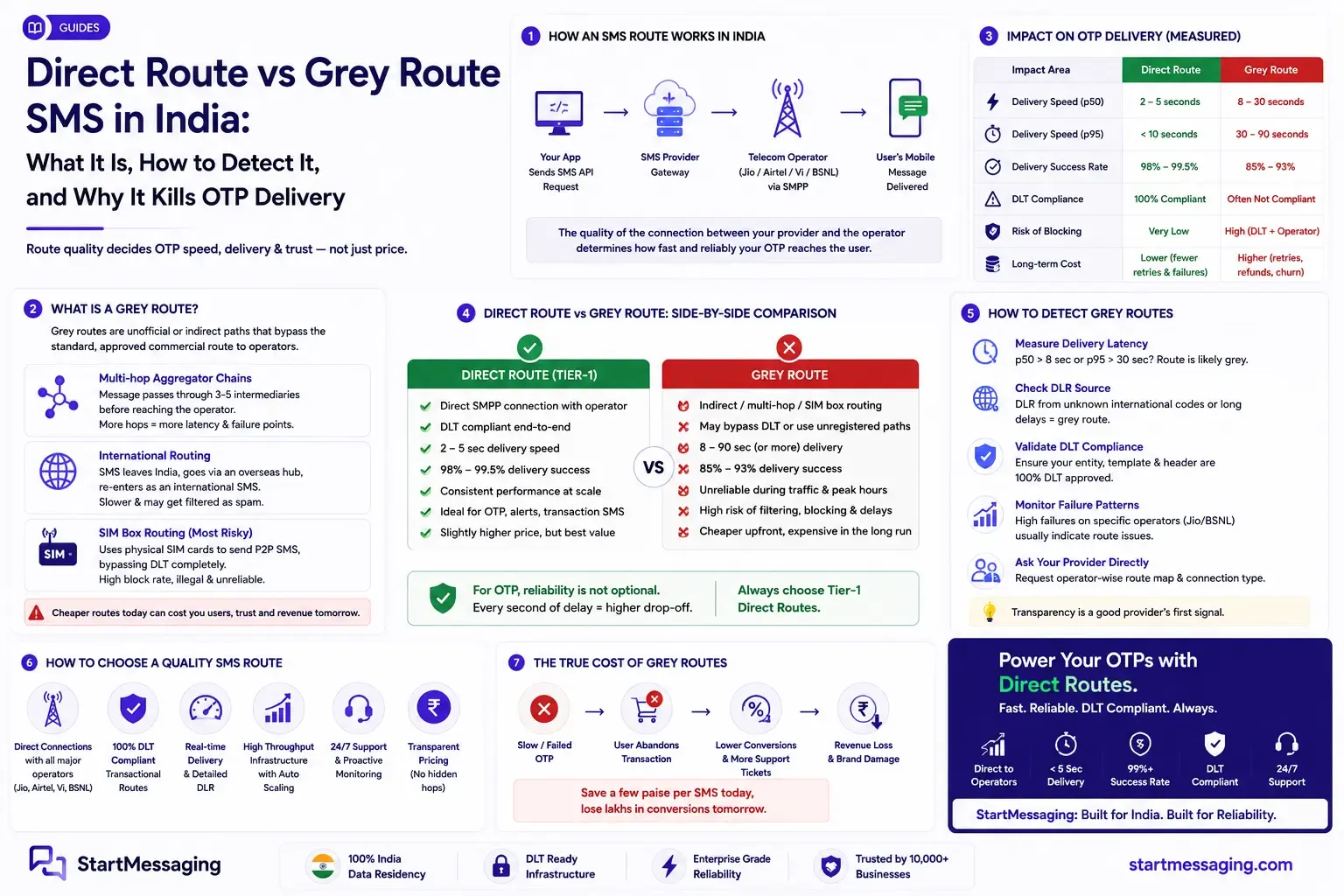
Priya stared at her terminal as the on-call alerts began to flood the dashboard at 2:00 AM. The verification page for her retail startup’s flash sale was showing a sudden drop in OTP delivery rates, plummeting from the standard 98% down to 71%. In the engineering channel, support agents reported that customers were stuck on the confirmation screen, requesting resends that never arrived. When Priya checked the logging console, the third-party SMS API returned a consistent list of success codes, reporting that every message had been dispatched successfully. The system logs showed no service errors or rate limit triggers. It was a silent failure: the API reported success, the company was billed for each request, but the end users received nothing. Priya was facing a classic symptom of grey route SMS transmission, a commercial workaround where providers cut costs by routing traffic through unauthorized carrier links.
Choosing an SMS API for user verification in India is often treated as a simple procurement decision based on the lowest cost per message. When startups compare pricing, they see options ranging from ₹0.12 to ₹0.25 per transaction. However, these low-cost options often hide the architectural compromises of grey routing. In the DLT-regulated Indian telecom network, saving fractions of a paisa on routing fees introduces structural delivery risks. Developers must understand how messages move through carriers to trace why verification codes fail silently and how to detect whether their provider uses Tier-1 direct carrier connection SMS India lines or cheap grey routes.
What a Route Actually Is in Indian SMS
To understand how messages fail, we must trace the path an SMS travels between your backend application and the user’s handset. The process begins when your server makes an HTTP API request to your SMS provider. The provider’s gateway receives the request, parses the destination phone number, matches the content template against registered DLT records, and converts the payload into SMPP (Short Message Peer-to-Peer) protocol packets.
From the gateway, the message must enter the core networks of India’s four primary telecom operators: Reliance Jio, Bharti Airtel, Vodafone Idea (Vi), and Bharat Sanchar Nigam Limited (BSNL). The connection between the SMS provider’s gateway and the operator’s Short Message Service Center (SMSC) is the routing path. Not all connections are set up in the same way, and the differences determine delivery speed and reliability:
- Tier-1 Direct Routes: The SMS provider maintains a direct SMPP connection to the telecom operator’s SMSC. When the provider’s gateway receives your API call, it transmits the message straight into the carrier’s primary delivery queue. There are no intermediate servers or reseller networks. The transaction is clean, direct, and carries operator-level delivery confirmations.
- Aggregator Routes: The SMS provider does not have a direct connection to the target operator. Instead, they buy message capacity from a larger aggregator, who may route the message to another reseller before it reaches the operator’s SMSC. Every hop between systems adds processing latency and introduces a new point of failure.
- Grey Routes: The provider routes the message through unauthorized channels that bypass standard commercial interfaces. The message travels through overseas gateways or local peer-to-peer workarounds to avoid paying interconnect fees.
Direct Route (Tier-1):
Your App -> SMS API -> Provider Gateway -> Direct SMPP -> Operator SMSC -> User Handset

Grey Route (Workaround):
Your App -> SMS API -> Gateway -> Reseller -> International Gateway -> Operator SMSC -> User Handset
The difference between these paths has immediate consequences for transaction success. A direct connection allows the provider to receive instant, network-level status notifications from the carrier, which are forwarded to your webhook handler. Multi-hop and grey routes strip away these carrier confirmations. The reseller’s gateway marks the message as delivered as soon as it passes the packet to the next hop, even if the intermediate server drops the data or the carrier blocks it. For transactional OTPs, where every second of delay increases user friction, route quality is the single most important factor in authentication performance.
Grey Routes Explained: How They Operate Behind the Scenes
A grey route is any transmission path that exploits a commercial loophole to deliver messages while avoiding standard local interconnection fees. In the Indian telecom sector, operator agreements classify SMS traffic into two distinct commercial streams: domestic transactional/commercial traffic and peer-to-peer (P2P) personal messaging. Transactional routes are subject to strict regulatory fees, DLT scrubbing charges, and operator termination costs. Personal P2P routing is priced lower or bundled into consumer mobile plans.
Grey routing occurs when a provider disguises commercial traffic as peer-to-peer messaging or routed it through international networks to skip domestic termination fees. A common method is SIM box routing, which uses physical hardware holding hundreds of consumer SIM cards. The provider’s gateway receives your transactional API request, forwards the payload over the internet to a local SIM box, and the SIM box transmits the OTP as a standard peer-to-peer SMS from a local mobile number.
SIM Box Routing Flow:
API Request -> Local Internet -> SIM Box Hardware -> Consumer SIMs -> Operator -> Handset
The primary driver for grey routes is cost optimization. Operating direct SMPP links with Jio or Airtel requires substantial financial commitments, infrastructure compliance, and licensing. The termination fee charged by Indian operators for domestic transactional SMS is fixed by commercial agreements. A provider using direct lines cannot drop prices below these wholesale carrier fees without losing money. In contrast, grey routes bypass these charges, allowing providers to offer rates that are 50% lower than wholesale direct routes. This cost difference is why the cheapest providers on the market almost always rely on compromised routing pipelines.
The deployment of the Telecom Regulatory Authority of India’s (TRAI) Distributed Ledger Technology (DLT) framework has made grey routes extremely high-risk for transactional delivery. Every business sending SMS messages in India must register their Principal Entity ID (PE-ID), their Sender ID, and their specific message templates on the operator’s ledger. When a message is sent over a direct, compliant route, the carrier’s SMSC queries the DLT database. If the template matches, the message is approved and sent.
If a message travels through a grey route, it skips standard commercial entry points and DLT metadata checks. Because SIM boxes transmit messages as peer-to-peer SMS from consumer numbers, they do not include the required headers or DLT metadata. When the operator’s automated network detects commercial content coming from a personal SIM or an unapproved international gateway, the system drops the message silently to prevent spam. The provider’s API returns a successful “sent” response to your server because the message was successfully delivered to the SIM box, but the carrier blocks it before it ever reaches the user’s handset.
The Measurable Toll: How Grey Routes Destroy OTP Delivery Rates
The choice between direct carrier lines and grey routes directly impacts user retention. In the Indian startup ecosystem, compromised routing manifests in four measurable performance bottlenecks:
- High Latency: A Tier-1 direct route transmits the OTP packet from your API to the handset in 2 to 5 seconds. In contrast, a grey route involving multi-hop aggregators or international routing loops typically takes 8 to 30 seconds to deliver. SIM box routing can extend this latency to 45 or 90 seconds. Since checkouts use a 30-second countdown timer, any delay past 15 seconds causes system failure. Our data indicates that 60% of users who wait more than 20 seconds for an OTP will click the “Resend” button or close the application.
- Low Baseline Delivery Rates: Direct routes achieve a 97% to 99% delivery rate on active mobile numbers in India. Grey routes operate at a baseline of 88% to 93% because they are vulnerable to network congestion and carrier blocks. A 6% drop in delivery rates means that for every 10,000 users attempting to register, 600 users are blocked by verification failures, losing customers at the final checkout step.
- Silent DLT Drops: When telecom filters trigger, the operator drops the SMS packet silently without returning a delivery failure receipt. Your provider’s API displays a successful delivery status because the packet reached their gateway, while your customer support desk is flooded with complaints. For a detailed look at troubleshooting late codes, see our guide on resolving delayed SMS delivery.
- Failure During Peak Festive Traffic: During major events like Diwali, cricket matches, or flash sales, carrier networks experience high traffic loads. To protect bandwidth, Indian operators prioritize traffic coming from direct Tier-1 SMPP connections and throttle messages arriving from secondary aggregators or international routes. Under peak load, grey route delivery rates can collapse from their 90% baseline down to less than 50%.
The Developer Checklist: How to Detect Grey Routes in Your App
If your current provider claims to use premium direct lines but your delivery metrics look suspicious, you can verify their routing quality using several diagnostics.
1. The Programmatic Latency Test
You can test latency by recording the duration between the API dispatch confirmation and the receipt of the operator’s delivery callback. The following Node.js script calculates the p50, p90, and p95 delivery latencies by querying your transaction database logs:
// analyzeLatency.js
async function getVerificationLogs() {
  return [
    { sent_at: 1719943200100, delivered_at: 1719943202600 },
    { sent_at: 1719943205300, delivered_at: 1719943213300 },
    { sent_at: 1719943210000, delivered_at: 1719943235200 },
    { sent_at: 1719943215200, delivered_at: 1719943218100 },
    { sent_at: 1719943220400, delivered_at: 1719943224200 }
  ];
}

function calculatePercentiles(logs) {
  const durations = logs
    .map(log => (log.delivered_at - log.sent_at) / 1000)
    .filter(val => val > 0)
    .sort((a, b) => a - b);

  if (durations.length === 0) return { p50: 0, p95: 0 };
  const getPercentile = (arr, p) => arr[Math.ceil((p / 100) * arr.length) - 1];

  return {
    p50: getPercentile(durations, 50),
    p95: getPercentile(durations, 95),
    average: durations.reduce((a, b) => a + b, 0) / durations.length
  };
}

(async () => {
  const logs = await getVerificationLogs();
  const metrics = calculatePercentiles(logs);
  console.log(`Median (p50): ${metrics.p50}s, p95: ${metrics.p95}s`);
  if (metrics.p50 > 8 || metrics.p95 > 25) {
    console.log("WARNING: High latency detected (likely grey route).");
  }
})();
To run this test effectively, collect at least 100 transaction samples. If your p50 latency is above 8 seconds, or if p95 exceeds 25 seconds, your traffic is likely running on a grey route.
2. Verify the Sender ID Format
In India, compliant transactional messages must display a registered 6-character alphabetic Sender ID (such as STRMSG or JIOOTP). If your test messages arrive showing a standard 10-digit mobile number, an international prefix (like +44 or +1), or a random numeric string, your provider is bypassing the local DLT network. This is a clear indicator of SIM box routing or an unauthorized international bypass.
3. Check for Operator-Level Delivery Receipts
A premium SMS API differentiates between gateway acknowledgment (sent) and handset delivery confirmation (delivered). If your provider’s delivery logs only show a single “sent” status and do not supply operator-level delivery receipts (DLR) as distinct events, they may lack direct SMPP connections. Without operator receipts, you cannot distinguish between a successful delivery and a silent carrier block.
4. Evaluate the Price Point
Analyze the economics of your SMS vendor’s pricing. Indian operators charge fixed wholesale termination fees for domestic transactional SMS. If a provider offers you transactional OTP rates below ₹0.12 or ₹0.15 per message, they cannot cover carrier termination fees on direct lines. Any rate below this wholesale floor is a strong indicator of grey or mixed routing.
Direct Route Infrastructure: StartMessaging’s Tier-1 Carrier Connections
StartMessaging is built specifically to address the reliability gap caused by cheap routing networks. The platform relies exclusively on Tier-1 direct carrier connection SMS India lines, maintaining direct SMPP links with India’s primary operators: Jio, Airtel, Vi, and BSNL. This infrastructure allows messages to enter carrier queues without passing through resellers.
By maintaining direct carrier connections, StartMessaging surfaces genuine network-level delivery receipts. When a verification code is sent, your backend receives real-time webhook callbacks as soon as the operator’s SMSC confirms delivery to the handset. This transparency allows developers to build smart fallback queues.
At a flat rate of ₹0.25 per message with no monthly fees, StartMessaging covers compliant operator termination fees. While slightly higher than grey route alternatives, the effective cost per successful verification is lower. A provider charging ₹0.12 with an 88% delivery rate forces you to pay for failed attempts and lose customers to checkout errors. StartMessaging’s 98% direct delivery rate ensures that you only pay for successful, secure conversions. For a broader look, review our analysis of bulk SMS API comparison options and check our guide on evaluating OTP delivery rates.
Frequently Asked Questions
Q: What is the difference between a Tier-1 and Tier-2 SMS route in India?
A: A Tier-1 route uses a direct SMPP connection between the SMS provider’s gateway and the telecom operator’s SMSC. A Tier-2 route involves intermediate aggregators, adding processing delay and stripping away handset-level delivery confirmations.
Q: How do I know if my SMS provider is using grey routes?
A: Monitor latency metrics: a median delivery time exceeding 8 seconds is highly suspect. Also check if sender IDs arrive as international phone numbers or numeric strings instead of registered 6-character alphabetic headers. Pricing below the wholesale carrier termination floor of ₹0.12–0.15 also signals grey routes.
Q: Does a grey route mean my OTPs will always fail, or just sometimes?
A: Grey routes fail inconsistently. A verification code may go through quickly, only to fail silently on the next request if the carrier updates spam filters or the aggregator path gets congested. This makes grey routes extremely damaging for transactional flows.
Q: Are grey routes illegal in India?
A: Yes. Bypassing local commercial routing agreements violates telecom regulations set by TRAI. Sending commercial content over unapproved paths or personal SIM cards can lead to carrier blocks and legal penalties for the sending business.
Q: What is a SIM box and why does it make OTP unreliable?
A: A SIM box is a physical hardware unit holding multiple personal SIM cards. It converts internet messages into peer-to-peer SMS traffic to bypass commercial fees. Operators block bulk traffic from personal numbers, causing silent drops and delivery delays.
Q: How much difference does route quality actually make to OTP delivery speed?
A: A direct Tier-1 route delivers codes in 2 to 5 seconds. A grey or multi-hop route can take 15 to 45 seconds, or fail to deliver entirely, directly impacting checkout conversions.
Priya migrated her retail startup’s verification controller from their low-cost bulk SMS vendor to StartMessaging’s direct API. Within hours, the checkout p50 latency dropped from 14 seconds to 2.4 seconds, and the overall delivery rate returned to a clean 98.6%. The silent DLT drops vanished, and the customer support queue cleared. If your team is struggling with unexplained verification delays or suspect carrier reporting, you can test your system’s performance and verify direct carrier delivery. Learn more about the StartMessaging API features or review our developer pricing to start optimizing your conversion pipeline.
StartMessaging Team
StartMessaging Team