Flash Call Verification in India vs SMS OTP: Honest Review
Flash call verification in India explained honestly. Compare flash call vs SMS OTP for cost, compliance, Android SDK, TRAI rules, and learn when each fits.
Rajan’s ride-sharing startup was burning ₹3.75 lakh per month on SMS OTP — 15 lakh verifications, ₹0.25 each. His growth team flagged flash call verification as a way to cut that bill by 60%. “We can verify users for ₹0.05 instead of ₹0.25,” the pitch went. Rajan’s CTO instinct said: run the numbers properly. What he found over the next two weeks of testing was more complicated — and more honest — than any vendor’s sales deck. Flash call genuinely saves money under the right conditions, but it also has regulatory grey areas that enterprise risk teams need to evaluate, hard platform limitations on iOS and BSNL that mean SMS OTP fallback is not optional, and Android SDK requirements that add engineering overhead most vendors do not mention upfront. This is that honest review.
Flash Call vs Missed Call vs Voice OTP: Getting the Terminology Right
Indian developers regularly confuse three distinct call-based verification methods. They use different mechanisms, have different cost structures, and face different regulatory treatment. Getting the terminology wrong leads to bad architecture decisions.
Voice OTP
Voice OTP is the simplest to understand: the system calls the user, the call connects, and an automated voice reads out the verification code. The user listens to the code and types it into the app. This is an IVR-based flow — the call must be answered, the user must listen, and the experience is manual. Voice OTP is already covered in a separate post and is a different product entirely from flash call.
Missed Call Verification
Missed call verification flips the direction. The user calls a designated phone number (often a toll-free or local number). The system detects the incoming call, identifies the caller’s number from the CLI, and confirms that the number is real and active. No code is exchanged — the call itself is the verification. This method is popular for lead generation and number confirmation flows where you need to verify that a phone number exists, not that the user possesses a secret.
Flash Call / CLI Verification
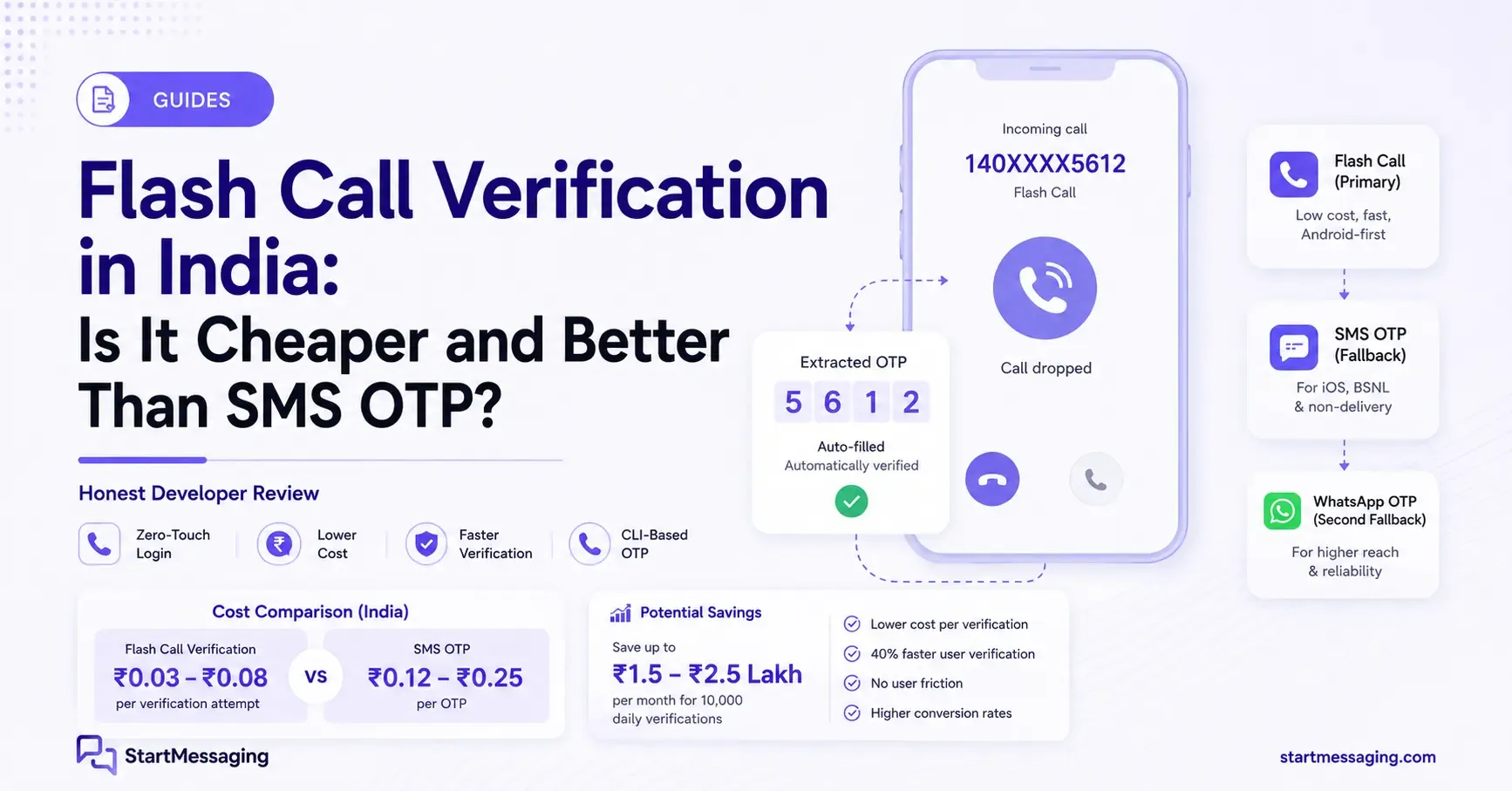
Flash call is the most technically sophisticated of the three. The system places a call to the user’s mobile number and disconnects it before the phone fully rings. The verification “code” is embedded in the Caller Line Identification (CLI) — specifically, the last 4–6 digits of the incoming number. For Android users, an SDK reads the call log, extracts those digits, and auto-submits them to your backend. The user sees nothing — the entire verification completes in 3–5 seconds without any interaction.
Why the Distinction Matters
Each method has a different cost structure: voice OTP costs ₹0.30–₹0.80 per call (full IVR connection). Missed call verification costs ₹0.01–₹0.05 per call (toll-free incoming). Flash call costs ₹0.03–₹0.08 per attempt (brief outgoing call). Each has different regulatory treatment under TRAI. And each requires different SDK capabilities on the client side. Confusing them leads to wrong cost projections and wrong compliance assumptions.
How Flash Call Verification Works Technically
The technical flow involves five components: your app, your backend, the flash call provider, the telephony network, and the Android call log.
The Verification Flow
- User enters their phone number in your app’s signup or login screen.
- Your backend sends a verification request to the flash call provider, passing the phone number.
- The provider allocates a temporary outbound number whose last 4–6 digits are the verification code. The provider tells your backend what these digits are.
- The provider places a call from that temporary number to the user’s mobile. The call is designed to drop within 1–3 seconds — before the user can answer, and in many cases before the phone rings audibly.
- The Android SDK on the user’s device detects the incoming call via
CallLog.Calls, extracts the last digits of the caller ID, and submits them to your backend automatically. - Your backend compares the submitted digits against what the provider communicated in step 3. If they match, the number is verified.
The total elapsed time is 3–5 seconds. The user did not type anything, did not switch apps, and may not have noticed the call at all. When it works, the experience is genuinely seamless.
Android SDK Integration
The SDK needs access to the device’s call log. On Android, this requires the READ_CALL_LOG permission, which is one of Google Play’s most tightly controlled permissions.
// AndroidManifest.xml
<uses-permission android:name="android.permission.READ_CALL_LOG" />

// Detecting the flash call in your verification receiver
ContentResolver resolver = getContentResolver();
Cursor cursor = resolver.query(
    CallLog.Calls.CONTENT_URI,
    new String[]{CallLog.Calls.NUMBER, CallLog.Calls.DATE, CallLog.Calls.TYPE},
    CallLog.Calls.TYPE + " = ? AND " + CallLog.Calls.DATE + " > ?",
    new String[]{String.valueOf(CallLog.Calls.MISSED_TYPE), String.valueOf(verificationStartTime)},
    CallLog.Calls.DATE + " DESC"
);

if (cursor != null && cursor.moveToFirst()) {
    String incomingNumber = cursor.getString(cursor.getColumnIndex(CallLog.Calls.NUMBER));
    // Extract last 4-6 digits as the verification code
    String verificationCode = incomingNumber.substring(incomingNumber.length() - 6);
    // Submit to your backend for verification
    verifyWithBackend(verificationCode);
    cursor.close();
}
Google Play policy (2026): Google restricts READ_CALL_LOG to apps where call log access is a core feature. You must submit a declaration explaining why your app needs this permission, and Google reviews it. Phone verification is an accepted use case, but expect the review cycle to add 1–2 weeks to your Play Store approval process. Some developers have reported rejections on first submission, requiring resubmission with a more detailed justification.
iOS Reality
Flash call autofill does not work on iOS. Apple does not allow apps to read the call log under any circumstances. There is no iOS equivalent of READ_CALL_LOG, and no SDK workaround exists. When a flash call reaches an iPhone, the user sees a brief missed call notification but has no way to extract the verification digits automatically.
Your options for iOS users are limited:
- Display the incoming number and ask the user to manually enter the last 4–6 digits. This defeats the “zero-touch” advantage.
- Fall back to SMS OTP automatically for all iOS users. This is the practical choice.
Calculate what percentage of your Indian users are on iOS. Nationally, iOS is roughly 4–5% of the smartphone market. In metro cities and among higher-income demographics, it can be 15–25%. Your SMS fallback volume scales directly with your iOS user share.
BSNL Reality
CLI delivery on BSNL is inconsistent. BSNL’s network infrastructure does not always propagate the full caller ID for brief calls, particularly calls that disconnect before the first ring completes. In testing, flash call verification on BSNL subscribers shows a 60–70% success rate compared to 90%+ on Jio and Airtel. Plan for 100% SMS fallback for BSNL users.
Cost Comparison: Flash Call vs SMS OTP in India
Cost is the primary driver of flash call adoption — and it is exactly what drew Rajan’s attention. The per-attempt savings are real, but the true cost picture is more complex than the headline number suggests. Here is what Rajan found when his team ran the actual numbers.
Per-Message Pricing
| Method | Cost per attempt | Notes |
|---|---|---|
| SMS OTP (market range) | ₹0.12–₹0.25 | DLT-compliant, universal reach |
| SMS OTP (StartMessaging) | ₹0.25 | No DLT registration required, rate limiting included |
| Flash call verification | ₹0.03–₹0.08 | Operator-dependent, Android-only auto-verify |
| Voice OTP (IVR) | ₹0.30–₹0.80 | Full call connection required |
True Cost-Per-Verified-User
The per-attempt cost does not tell the full story. Flash call has a lower unit price, but you must account for the volume that falls back to SMS:
- iOS users (4–5% nationally, up to 25% in metro fintech apps): These must receive SMS OTP. Every iOS verification adds an SMS cost on top of your flash call infrastructure.
- BSNL users (approximately 8–10% of mobile subscribers): Low flash call success rate means most BSNL verifications become SMS fallbacks.
- Failed flash calls (network congestion, DND settings, Android skin variations): Roughly 5–10% of flash call attempts on supported networks fail and fall back to SMS.
A realistic cost model for 1,00,000 monthly verifications:
| Scenario | Flash call + SMS fallback | SMS OTP only (StartMessaging) |
|---|---|---|
| Flash call attempts (75% of volume) | 75,000 × ₹0.05 = ₹3,750 | — |
| SMS fallback (25% of volume) | 25,000 × ₹0.25 = ₹6,250 | — |
| SMS OTP (100% of volume) | — | 1,00,000 × ₹0.25 = ₹25,000 |
| Total monthly cost | ₹10,000 | ₹25,000 |
| Monthly savings | ₹15,000 | — |
At 1 lakh messages per month, flash call saves roughly ₹15,000/month (₹1.8 lakh annually). At 10 lakh messages per month, the savings scale to ₹1.5 lakh/month (₹18 lakh annually). These are real savings that justify the integration effort for high-volume consumer apps. Rajan’s 15 lakh monthly verifications put him squarely in the “worth it” zone — his projected annual saving was ₹27 lakh. But the hidden costs changed that calculation.
Hidden Costs
The cost model above does not include:
- Android SDK maintenance: Google’s Play Store policies around
READ_CALL_LOGchange. Each policy update requires review, potential code changes, and resubmission. - Play Store permission review cycles: Initial review adds 1–2 weeks. Policy changes can require re-review.
- Fallback logic engineering: Building and maintaining the flash call → SMS fallback pipeline is a non-trivial engineering investment. Testing across Jio, Airtel, Vi, and BSNL with different Android versions and OEM skins is an ongoing cost.
- Provider integration: Flash call providers charge setup fees or minimum monthly commitments that do not apply to pay-as-you-go SMS APIs.
Break-Even Calculation
At what monthly volume does the flash call integration effort pay off? Assume the integration takes a senior developer 2–3 weeks (cost: ₹1.5–₹3 lakh including testing). Ongoing maintenance is approximately 2–3 days per quarter.
| Monthly volume | Monthly savings | Months to break even (₹2 lakh integration cost) |
|---|---|---|
| 10,000 verifications | ₹1,500 | 133 months (not worth it) |
| 50,000 verifications | ₹7,500 | 27 months |
| 1,00,000 verifications | ₹15,000 | 13 months |
| 5,00,000 verifications | ₹75,000 | 3 months |
The break-even is clear: below 50,000 monthly verifications, the integration cost does not justify the savings. Above 1,00,000, the payback period is under a year. Above 5,00,000, flash call pays for itself in a single quarter.
TRAI and RBI Compliance: The Questions Nobody Is Answering
Flash call verification occupies a regulatory grey area in India. This is the section that most vendor documentation conveniently omits — and the section that made Rajan pause before committing to a production rollout.
Does Flash Call Require DLT Registration?
Honest answer: no. TRAI’s DLT framework governs commercial SMS — specifically, messages sent through telecom operators’ SMS infrastructure. Flash calls are telephone calls, not SMS messages. They fall under a different regulatory domain (telephony, not commercial communications). There is no DLT registration requirement for placing a phone call and disconnecting it.
This is genuinely an advantage for developers who find DLT registration burdensome. But it is also the reason regulators have been wary — flash call sidesteps the compliance framework that TRAI built specifically to control commercial messaging.
Does Flash Call Satisfy RBI’s Authentication Requirements?
The RBI Authentication Mechanisms Directions, 2025 require two-factor authentication for digital payments, with at least one dynamic factor. A flash call verification code is dynamic (different for each attempt) and transaction-specific. It proves possession of the registered mobile device (the SIM receives the call).
On paper, flash call satisfies the “something you have” requirement. In practice, the regulatory acceptance is less clear than SMS OTP, which has years of precedent as an accepted payment authentication factor. If you are building payment authentication for a regulated entity (bank, NBFC, PPI issuer), your compliance team should evaluate whether flash call has sufficient regulatory precedent before replacing SMS OTP in payment flows.
For non-payment verification (app signup, login, account recovery), flash call faces no RBI-related compliance concerns. The RBI directive applies specifically to digital payment transactions.
Disclaimer: This is informational content, not legal advice. Consult a compliance officer for your specific regulatory situation.
DPDP Act 2023: Call Logs Are Personal Data
This is the compliance issue that developers overlook. The DPDP Act, 2023 classifies call logs as personal data. When your SDK reads the user’s call log to extract the flash call verification code, you are processing personal data. This requires:
- Explicit consent: Your app must inform the user that you will access their call log for verification purposes and obtain consent before doing so.
- Purpose limitation: You may only use the call log data for verification. Reading other call entries, storing call history, or using the data for analytics violates purpose limitation.
- Data minimisation: Extract only the verification digits and discard the call log query results immediately. Do not persist any call log data beyond the verification session.
Non-compliance carries penalties under the DPDP Act. Implement consent screens and data handling policies before deploying flash call in production.
The Current Grey Area
TRAI has not formally classified flash call under any existing regulatory framework. It is not SMS (so DLT does not apply). It is not a commercial communication in the traditional sense (the call carries no voice content). It is not spam (the call is initiated by the user’s own verification request). But telecom operators have publicly objected to flash call traffic because it uses network signalling resources without generating call revenue. Jio and Airtel have been known to rate-limit or filter flash call patterns during peak hours.
What this means for enterprise risk tolerance: if your company operates in a regulated industry (banking, insurance, lending), the regulatory uncertainty around flash call is a risk factor. SMS OTP has clear regulatory standing. Flash call does not — yet. Startups and consumer apps with higher risk tolerance can adopt flash call today; regulated enterprises should monitor regulatory developments before committing. Rajan’s ride-sharing app sits in the middle: not regulated like a bank, but handling payments via UPI Autopay. His compliance team flagged it as “acceptable for login, but keep SMS for payment authentication.”
Who Should Use Flash Call in India (and Who Should Not)
Good Fit
- High-volume consumer Android apps where the majority of users are on Jio or Airtel in urban metro areas. Ride-sharing, food delivery, social media, and gaming apps with 1,00,000+ monthly verifications see the most compelling cost savings.
- Apps where user friction is the primary drop-off cause. If your funnel analytics show significant abandonment at the OTP entry screen, flash call’s zero-touch experience directly addresses that problem.
- Startups with cost-sensitive unit economics. When you are verifying lakhs of users monthly and SMS costs are a meaningful line item in your P&L, the 50–70% per-verification cost reduction matters.
Poor Fit
- Apps serving rural or tier-3 users. BSNL dominance, feature phone usage, and inconsistent call log delivery make flash call unreliable. SMS OTP is the only universal channel.
- Regulated BFSI apps. Banks, NBFCs, insurance companies, and payment apps where RBI compliance clarity is a hard requirement. The regulatory grey area around flash call creates audit risk that most compliance teams will not accept.
- B2B SaaS where the SMS audit trail is valued. Enterprise buyers expect SMS delivery receipts, DLT compliance records, and a clear regulatory paper trail. Flash call does not provide this.
- Web-only flows. Flash call requires a mobile app with call log permissions. If your verification happens on a website, flash call is not an option.
The Smart Architecture
The most cost-effective verification stack for Indian consumer apps in 2026 combines multiple channels with automatic fallback:
async function verifyUser(phoneNumber, platform) {
  // Step 1: Determine primary channel based on platform and carrier
  if (platform === 'android' && !isBsnlNumber(phoneNumber)) {
    // Attempt flash call for eligible Android users
    const flashResult = await attemptFlashCall(phoneNumber);

    if (flashResult.verified) {
      return { channel: 'flash_call', status: 'verified', cost: 0.05 };
    }
  }

  // Step 2: Fallback to SMS OTP via StartMessaging
  const smsResult = await fetch('https://api.startmessaging.com/otp/send', {
    method: 'POST',
    headers: {
      'Content-Type': 'application/json',
      'X-API-Key': process.env.STARTMESSAGING_API_KEY,
    },
    body: JSON.stringify({
      phoneNumber: phoneNumber,
      expiry: 300,
    }),
  });

  if (smsResult.ok) {
    return { channel: 'sms', status: 'otp_sent', cost: 0.25 };
  }

  // Step 3: Second fallback to WhatsApp OTP for non-deliveries
  const waResult = await sendWhatsAppOtp(phoneNumber);
  return { channel: 'whatsapp', status: waResult.status, cost: 0.35 };
}
The fallback order — Flash Call → SMS OTP → WhatsApp OTP — optimises for cost on the happy path and reach on the fallback paths. Flash call handles the cheapest verifications for eligible users. SMS OTP via StartMessaging catches everyone else with universal reach at ₹0.25 per message. WhatsApp OTP serves as the last resort for edge cases where both flash call and SMS fail.
Frequently Asked Questions
Q: Is flash call verification legal in India under TRAI rules?
A: Flash call is not explicitly regulated or banned by TRAI. It falls outside the DLT framework because it is a phone call, not an SMS. TRAI has not issued a specific directive on flash call verification. Telecom operators have expressed concerns about flash call traffic using signalling resources without revenue, and some operators may rate-limit or filter the traffic. There is no legal prohibition, but there is regulatory uncertainty that your compliance team should evaluate.
Q: Can flash call autofill work on iPhones in India?
A: No. Apple does not allow apps to access the call log under any circumstances. Flash call verification on iOS requires the user to manually read the incoming number and type the digits, which defeats the zero-touch advantage. The practical approach is to detect iOS devices and send SMS OTP directly, skipping the flash call attempt entirely.
Q: Does flash call verification count as 2FA under RBI guidelines?
A: Flash call proves possession of the SIM that received the call, which satisfies the “something you have” category in RBI’s authentication framework. A flash call verification code is dynamic and transaction-specific. On paper, it qualifies. In practice, SMS OTP has explicit regulatory precedent as an accepted payment authentication factor. Flash call does not have the same precedent. For payment flows in regulated entities, consult your compliance officer before replacing SMS OTP with flash call.
Q: What happens if the flash call does not drop in time — does the user’s phone ring?
A: Flash call providers configure the call to disconnect within 1–3 seconds, typically before the phone rings audibly. On most devices, the user sees a brief missed call notification but does not hear a ring. On some Android skins and with certain carrier configurations, the phone may ring once before the call drops. This is a UX concern, not a functional failure — the verification still works as long as the call appears in the call log. However, repeated calls that ring audibly can annoy users, particularly if the first attempt fails and you retry.
Q: Which providers offer flash call APIs in India?
A: Several global CPaaS providers offer flash call APIs that work with Indian carriers, including Sinch, Vonage, and Infobip. Indian aggregators are also beginning to offer flash call. Evaluate providers based on Jio and Airtel success rates specifically — global success rate claims may not reflect Indian carrier behaviour. For your SMS OTP fallback, StartMessaging provides ₹0.25-per-message delivery with no DLT registration required, making it the simplest fallback to integrate alongside any flash call provider.
Rajan ended up deploying flash call for Android login verifications and keeping SMS OTP for payment authentication and iOS users. His monthly OTP spend dropped from ₹3.75 lakh to ₹1.6 lakh — a 57% reduction, not the 60% the sales deck promised, but real money on a startup budget. The integration took his backend team 10 days, including testing across Jio, Airtel, Vi, and BSNL. The SMS fallback layer that catches iOS users, BSNL subscribers, and failed flash calls? That runs on StartMessaging’s OTP API at ₹0.25 per message — no DLT registration required, rate limiting and fraud detection built in. If you are evaluating flash call for your own stack, start with the fallback layer first. Sign up for free and get the SMS safety net in place — then add flash call on top for the users where it genuinely saves money.
StartMessaging Team
StartMessaging Team