RCS Business Messaging in India: Replace SMS OTP? (2026)
RCS business messaging in India explained for developers. Compare RCS vs SMS OTP for cost, delivery, verified branding, and learn when to use each channel.
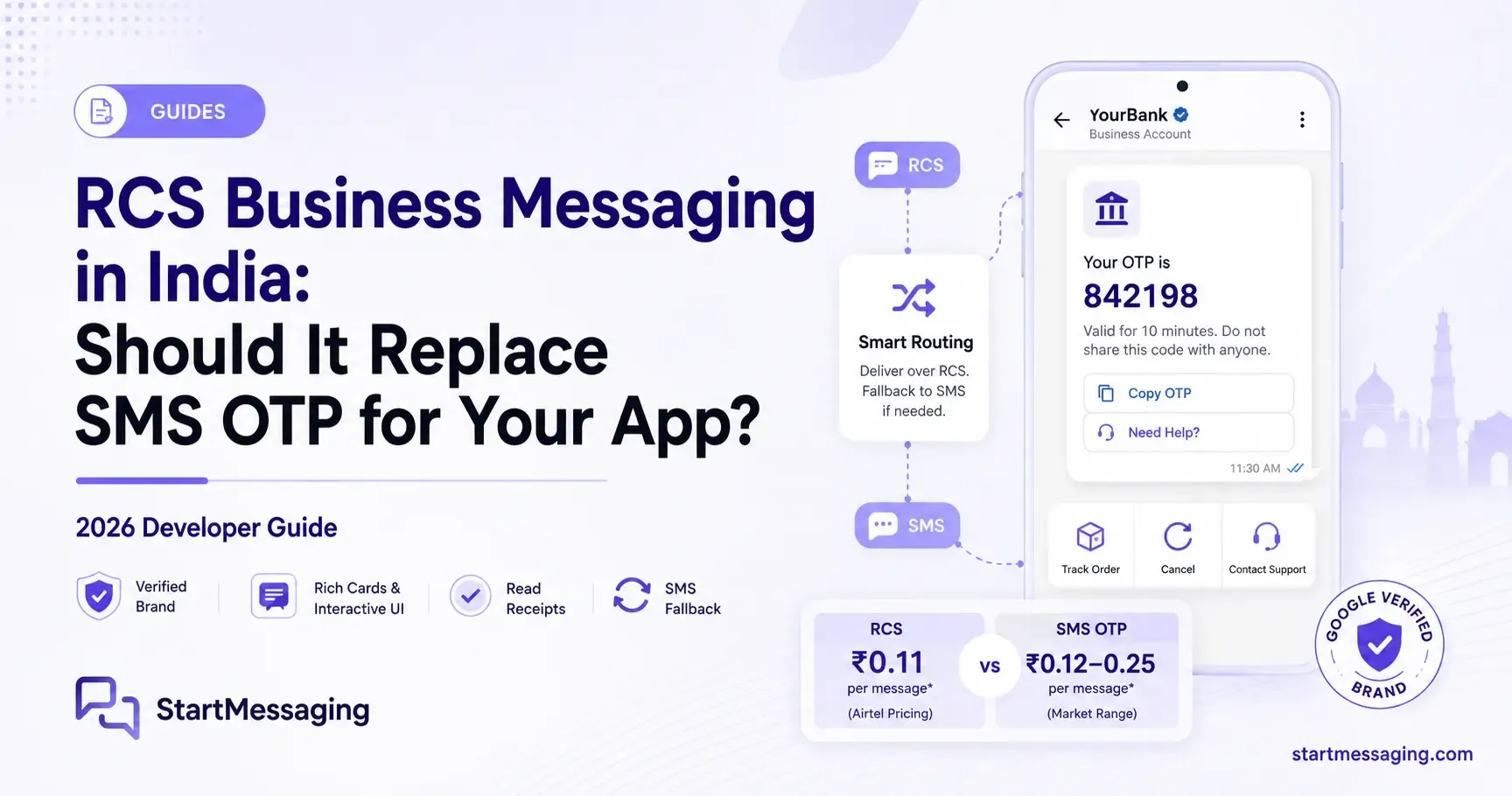
Meera’s e-commerce platform had a phishing problem. Three times in Q1 2026, scammers spoofed her company’s SMS sender ID, sent fake OTP messages to customers, and drained linked wallets. Her support team spent 400+ hours on fraud tickets. “Our users can’t tell a real OTP from a fake one,” she told her engineering lead. “The SMS looks identical.” That is the exact problem RCS Business Messaging solves — and it is why Meera started evaluating it seriously in March 2026, right after Airtel announced its Google AI-powered spam filtering partnership. RCS delivers OTPs with a verified brand badge, company logo, and interactive buttons inside the default messaging app. No more anonymous 6-digit codes from spoofable sender IDs.
But the honest picture is more complex than “RCS is better than SMS.” India’s RCS story changed meaningfully in 2026 — Jio, Airtel, and Vi all support it, Android users get it by default, and Apple added RCS support in iOS 18. This guide covers where RCS genuinely beats SMS OTP, where SMS still wins, how to integrate both into your stack with proper fallback, and a decision framework for choosing between the two.
What RCS Business Messaging Actually Is in India (2026 State of Play)
RCS (Rich Communication Services) is an IP-based messaging protocol that replaces plain SMS with a richer experience inside the user’s default messaging app. Think of it as SMS with superpowers: verified sender badges, read receipts, interactive buttons, rich cards with images, and carousel messages — all rendered natively without requiring a separate app installation.
RCS vs SMS: Technical Differences That Matter
The differences go beyond cosmetics. For developers building verification and transactional messaging flows, these are the technical differences that change your architecture:
| Capability | SMS | RCS Business Messaging |
|---|---|---|
| Sender identity | Short code or alphanumeric sender ID | Google-verified brand profile with logo, colour, description |
| Message format | Plain text, 160 characters (or concatenated) | Rich cards, carousels, suggested actions, images, up to 8,000 characters |
| Delivery confirmation | Delivery receipt (varies by carrier) | Read receipts — you know the user opened the message |
| Interactive elements | None — user must copy/paste or type | Buttons (URL, dialer, quick reply), suggested actions |
| Encryption | None (SS7 protocol) | TLS between device and Google servers |
| Fallback | None — message either arrives or does not | Automatic fallback to SMS if RCS is unavailable |
| Template approval | TRAI DLT registration | Google RCS Business Messaging agent verification |
Carrier Support Across India
All three major Indian telecom operators support RCS across their networks:
- Jio — Full RCS support. Jio’s 4G/5G-only network means every Jio subscriber has a data-capable connection, which is ideal for RCS delivery.
- Airtel — Full RCS support with carrier-level spam filtering added through the March 2026 Google AI partnership. Airtel charges ₹0.11 per RCS message under an 80:20 revenue-sharing arrangement with Google.
- Vi (Vodafone Idea) — RCS support available across its network. Coverage aligns with Vi’s 4G footprint.
- BSNL — Limited RCS support. BSNL’s 4G rollout is ongoing and RCS availability depends on circle-specific infrastructure upgrades.
What “Google Verified Brand” Means for OTP Trust
When you register as an RCS Business Messaging agent through Google, your brand name, logo, and verification badge appear on every message. The user sees your company identity — not a random 6-digit short code or an alphanumeric sender ID that could be spoofed. For OTP delivery, this has a direct impact on phishing resistance: a user can visually confirm that the OTP is coming from your verified brand, not from a fraudster imitating your sender ID in a plain SMS.
Cost Reality: RCS vs SMS OTP
Pricing is one of the most misunderstood aspects of RCS in India. Airtel’s published rate is ₹0.11 per RCS message under the 80:20 revenue-sharing model with Google. Compare that to SMS OTP pricing, which ranges from ₹0.12 to ₹0.25 per message depending on the provider and route.
On paper, RCS is cheaper per message. In practice, the total cost includes agent registration, template approval timelines, integration engineering, and the fact that you still need SMS fallback for every RCS send. The cost advantage is real at high volume, but the operational overhead is not zero.
RCS for OTP: What Works and What Does Not
RCS OTP is not a theoretical concept — it is being deployed by Indian fintech and e-commerce companies today. But the honest assessment is mixed.
Where RCS OTP Beats SMS OTP
Verified sender badge prevents phishing. This is the capability that caught Meera’s attention. The single biggest security advantage of RCS OTP is that SMS sender IDs can be spoofed — the exact vulnerability her platform was exploited through. RCS messages arrive with a Google-verified brand badge that users can trust. For high-value transactions (wallet loads, bank transfers, investment confirmations), this visual trust signal reduces the success rate of phishing attacks that rely on fake OTP messages.
Richer UI reduces user confusion. An SMS OTP is a string of digits in a thread full of other messages. An RCS OTP can be a branded card with your logo, the OTP code prominently displayed, a brief explanation of what the code is for, and action buttons like “I didn’t request this” or “Report suspicious activity.” This structured format reduces the cognitive load on users who receive dozens of SMS messages daily and may miss or confuse OTP messages.
Read receipts confirm delivery. With SMS, you get a delivery receipt — the carrier accepted the message. With RCS, you get a read receipt — the user actually opened and saw the message. This distinction matters for support workflows. When a user says “I never received my OTP,” you can check whether the message was read, which fundamentally changes how you debug delivery issues.
Interactive fallback buttons. You can embed a “Resend OTP” button directly in the RCS message, reducing friction when the user needs a new code. With SMS, the user must navigate back to your app and tap resend.
Where SMS OTP Still Wins
Feature phones. India still has roughly 15% of mobile users on feature phones that cannot receive RCS messages. These users are concentrated in rural and semi-urban markets, and they are disproportionately the users that financial inclusion programmes are trying to reach.
BSNL coverage gaps. BSNL’s inconsistent RCS support means that users on BSNL networks — particularly in rural areas and government employment — may not receive RCS messages reliably. SMS delivery on BSNL, while not perfect, is far more established.
Users without data. RCS requires an active data connection. Users who have exhausted their data pack, are in areas with poor data coverage, or have disabled mobile data will not receive RCS messages. SMS works over the signalling channel, independent of data connectivity.
DLT compliance clarity. SMS OTP under TRAI’s DLT framework has a well-defined compliance path. Templates are registered, approved, and scrubbed. RCS Business Messaging operates under Google’s agent verification process, which is a separate compliance track. For enterprises that need regulatory audit trails, the DLT path has years of precedent and regulatory familiarity.
The Fallback Reality
This is the most important technical fact about RCS in India: if the user’s device is offline, does not support RCS, or the RCS delivery fails for any reason, the message automatically falls back to regular SMS. No message is ever lost. This fallback is built into the RCS protocol and handled at the carrier/Google level — but you still need to account for it in your architecture because the fallback SMS will be plain text without the rich formatting, verified badge, or interactive buttons.
RBI’s Authentication Directions: Does RCS OTP Qualify?
RBI’s Authentication Mechanisms Directions, 2025 require two-factor authentication for digital payments. The directive mandates that at least one factor be “dynamic and transaction-specific.” An RCS-delivered OTP satisfies this requirement identically to an SMS-delivered OTP — the transport channel does not change the authentication factor category. RCS OTP counts as “something you have” (possession of the registered mobile device) and is dynamic.
The RBI directive does not specify which delivery channel must carry the OTP. An RCS OTP meets the same regulatory requirements as an SMS OTP for digital payment authentication.
Disclaimer: This is informational content, not legal advice. Consult a compliance officer for your specific regulatory situation.
RCS for Notifications and Transactional Messaging
OTP is only one use case. The stronger argument for RCS in India right now is transactional and notification messaging, where the rich UI capabilities create genuine user experience improvements.
Where RCS Is Clearly Superior to SMS
Order tracking with interactive buttons. An e-commerce platform can send an RCS message with the order status, tracking number, estimated delivery time, and three action buttons: Track Package, Contact Support, Cancel Order. Compare this to a plain SMS that reads “Your order #12345 has shipped. Track at https://track.example.com/12345.” The RCS version keeps the user in the messaging app and reduces the steps to take action.
Payment receipts with brand identity. A fintech app can send a payment confirmation as a rich card with the company logo, transaction amount, merchant name, date, and a “View Statement” button. The branded format builds trust and reduces the “was this a legitimate charge?” anxiety that drives support calls.
Appointment reminders with Confirm/Reschedule buttons. Healthcare providers, salons, and service businesses can send appointment reminders with one-tap Confirm or Reschedule buttons. This replaces the SMS flow where users must call back or visit a website to confirm. For Indian healthcare apps, where no-show rates directly affect revenue, the one-tap confirmation creates measurable conversion improvement.
Indian Industries Moving Fastest on RCS
- E-commerce: Order confirmations, shipping updates, delivery notifications, return status — all benefit from rich cards and action buttons.
- Fintech: Transaction alerts, payment confirmations, account activity notifications, KYC reminders with document upload prompts.
- Airlines: Boarding passes with barcode, gate change notifications, check-in reminders with action buttons.
- Healthcare: Appointment reminders, prescription refill notifications, lab report availability with “View Report” buttons.
Template Approval: RCS via Google vs DLT
DLT template registration in India involves registering with a TRAI-approved DLT platform (JioTrueConnect, Airtel IQ, Vi Business, Vodafone DLT), submitting message templates with variable placeholders, and waiting 2–7 business days for approval. Template rejections require resubmission and the cycle repeats. The process is well-documented but bureaucratic.
RCS Business Messaging agent registration goes through Google’s verification process. You submit your brand details, logo, and sample messages. Google verifies your business identity and approves your agent profile. Template approval for RCS messages is typically faster — 1–3 business days — and the approval criteria are more about brand verification than content scrubbing.
For teams that have struggled with DLT template rejections, the RCS approval process is a welcome change.
Developer Integration: The API Reality
Sending RCS Business Messages in India requires either direct integration with Google’s Business Communications API or working through an aggregator that abstracts the complexity.
The API Landscape
Google’s Business Communications API is the direct path. You register as an RCS Business Messaging partner, create an agent (your brand identity), submit for verification, and then send messages through the API. The API supports text messages, rich cards, carousels, and suggested actions. The integration is REST-based and well-documented, but the onboarding process takes 2–4 weeks for verification.
Aggregator APIs (like StartMessaging’s unified messaging API) abstract the channel routing. You send a message through a single API endpoint, and the aggregator handles RCS delivery with automatic SMS fallback. This is the faster path for developers who do not want to manage Google’s partner onboarding process directly.
SMS Fallback Architecture
Every RCS implementation in India must include SMS fallback. There are no exceptions. Here is a clean pattern in Node.js for handling RCS-first delivery with SMS fallback:
async function sendVerificationMessage(phoneNumber, otpCode, brandName) {
  // Step 1: Attempt RCS delivery
  const rcsResult = await sendRcsMessage({
    to: phoneNumber,
    agent: brandName,
    contentMessage: {
      text: `Your verification code is ${otpCode}. Valid for 5 minutes.`,
      suggestions: [
        { reply: { text: "I didn't request this", postbackData: "report_suspicious" } }
      ]
    }
  });

  // Step 2: Check RCS delivery status within SLA
  const rcsDelivered = await waitForDeliveryStatus(rcsResult.messageId, 3000);

  if (rcsDelivered) {
    return { channel: 'rcs', messageId: rcsResult.messageId, status: 'delivered' };
  }

  // Step 3: Fallback to SMS OTP via StartMessaging
  const smsResult = await fetch('https://api.startmessaging.com/otp/send', {
    method: 'POST',
    headers: {
      'Content-Type': 'application/json',
      'X-API-Key': process.env.STARTMESSAGING_API_KEY,
    },
    body: JSON.stringify({
      phoneNumber: phoneNumber,
      expiry: 300,
    }),
  });

  const smsData = await smsResult.json();
  return { channel: 'sms', messageId: smsData.messageId, status: 'sent' };
}
The critical design decision: keep the same OTP code, expiry, and rate limits across both channels. Do not generate a new code for the SMS fallback — the user should enter the same code regardless of which channel delivered it.
Cost Model: When Does RCS Become Cheaper Than SMS at Scale?
The break-even calculation depends on your volume, your SMS provider’s pricing, and your RCS delivery success rate.
| Monthly volume | SMS cost (₹0.25/msg) | RCS cost (₹0.11/msg) | Monthly savings | Annual savings |
|---|---|---|---|---|
| 10,000 messages | ₹2,500 | ₹1,100 | ₹1,400 | ₹16,800 |
| 50,000 messages | ₹12,500 | ₹5,500 | ₹7,000 | ₹84,000 |
| 1,00,000 messages | ₹25,000 | ₹11,000 | ₹14,000 | ₹1,68,000 |
| 5,00,000 messages | ₹1,25,000 | ₹55,000 | ₹70,000 | ₹8,40,000 |
These numbers assume 100% RCS delivery, which is unrealistic. Factor in that 15–25% of your messages will fall back to SMS (feature phones, BSNL users, no-data scenarios), and your actual RCS savings are lower. At 50,000+ messages per month, the per-message cost savings typically justify the integration engineering investment within 3–6 months. Meera’s platform sends 2 lakh transactional messages per month — at that volume, the switch to RCS-first would save roughly ₹28,000/month (₹3.36 lakh annually), even after accounting for SMS fallback on 20% of traffic.
What You Cannot Do on RCS Yet in India
- BSNL reach: RCS delivery on BSNL remains inconsistent. Plan for 100% SMS fallback for BSNL subscribers.
- iOS interactive buttons: Apple added RCS support in iOS 18, but the interactive button and rich card features are not fully supported in the same way as on Android’s Google Messages. iOS users receive a simpler version of your RCS message.
- Template approval timelines: Google’s agent verification can take 2–4 weeks. Budget this into your launch timeline.
- Autofill integration: SMS Retriever API on Android enables automatic OTP autofill from SMS. RCS does not have an equivalent autofill mechanism yet. If zero-touch OTP entry is critical to your flow, SMS with SMS Retriever remains the better experience.
Decision Framework: RCS vs SMS OTP for Your App
Use RCS If
Your users are primarily urban, Android-heavy, in fintech or e-commerce, and you want verified branded messages that build trust and reduce phishing — exactly Meera’s situation. RCS is the right primary channel when your analytics show 80%+ of your users are on Jio or Airtel Android devices, and your use case benefits from interactive elements (order tracking, payment confirmations, appointment reminders). The ₹0.11 per-message cost advantage compounds meaningfully above 50,000 messages per month.
Stick with SMS OTP If
Your user base includes rural or semi-urban segments, feature phone users, or users who frequently run out of data. If you serve a BSNL-heavy demographic, need guaranteed delivery regardless of data connectivity, or send pure OTP without any need for rich UI, SMS OTP is the reliable, regulation-proven choice. StartMessaging’s OTP API gives you ₹0.25-per-message delivery with no DLT registration required, rate limiting, and fraud detection built in.
Run Both If
You have volume above 50,000 messages per month and can absorb the integration complexity for the conversion and cost improvements. The smart architecture is RCS as primary with automatic SMS fallback — one verification ID server-side, attempt RCS delivery, fall back to SMS within a tight SLA (2–3 seconds), keep the same code and expiry across channels. A unified API that routes to RCS with automatic SMS fallback gives you one integration point and the best of both channels.
Frequently Asked Questions
Q: Does RCS cost more than SMS in India?
A: No. RCS is cheaper per message — ₹0.11 on Airtel’s published rate versus ₹0.12–0.25 for SMS depending on the provider. The total cost of ownership is higher initially because of agent registration, integration engineering, and mandatory SMS fallback infrastructure. At volumes above 50,000 messages per month, the per-message savings typically outweigh the integration costs within 3–6 months.
Q: Is RCS DLT-compliant or does it have its own registration process?
A: RCS operates under Google’s agent verification process, which is separate from TRAI’s DLT framework. DLT applies to SMS; RCS has its own brand verification and template approval track through Google. If you run a hybrid stack (RCS primary + SMS fallback), you need compliance coverage for both paths. StartMessaging handles DLT for your SMS fallback so you only need to manage the RCS agent verification on Google’s side.
Q: Can I send an OTP via RCS and have it autofill like SMS Retriever?
A: Not yet. Android’s SMS Retriever API works specifically with SMS messages. RCS does not have an equivalent autofill mechanism as of mid-2026. If zero-touch OTP entry is critical to your conversion flow, use SMS with SMS Retriever as the primary channel and consider RCS for non-OTP transactional messages where interactive buttons add value.
Q: What happens to my RCS message if the user has no internet?
A: The message automatically falls back to regular SMS. This is built into the RCS protocol and handled at the carrier and Google level. The fallback SMS will be plain text — no rich card, no buttons, no verified badge — but the message content (including the OTP code) will be delivered. No message is lost due to connectivity issues, which is why RCS with SMS fallback has the same universal reach as SMS alone.
Q: How does RCS compare to WhatsApp Business API for messaging in India?
A: Both are rich messaging channels, but they differ in reach and cost model. RCS renders inside the default messaging app with no installation required. WhatsApp requires the app to be installed. RCS at ₹0.11 per message is cheaper than WhatsApp authentication conversations. WhatsApp has higher engagement rates and end-to-end encryption. For businesses that already use WhatsApp OTP, RCS is a complementary channel, not a replacement. The ideal stack for Indian businesses in 2026 is RCS for transactional notifications → SMS OTP for authentication → WhatsApp for customer engagement.
Meera’s team rolled out RCS for order confirmations and payment receipts in April 2026. The verified brand badge solved her phishing problem — zero spoofing incidents since launch. Her OTP flow still runs on SMS because of the autofill advantage (SMS Retriever), but the transactional messages that used to look identical to phishing attempts now arrive with her company logo, verification badge, and interactive buttons. The phishing complaints that consumed 400 hours of support time? Down to zero in the last quarter. RCS Business Messaging is real in India — not a pilot, not a future promise. The carrier support is in place, the pricing is competitive, and the verified brand experience genuinely improves trust. But SMS OTP is not dying. It remains the universal fallback, the DLT-compliant default, and the only channel that reaches every Indian mobile user regardless of device, carrier, or connectivity. The smart architecture uses both. StartMessaging’s API gives you the SMS OTP layer with ₹0.25-per-message pricing, no DLT registration required, and built-in rate limiting — the reliable fallback that every RCS implementation needs. Sign up for free and add the SMS foundation before you build the RCS layer on top.
StartMessaging Team
StartMessaging Team