SMS OTP for India's Digital Health Apps: Compliance Guide (2026)
Learn how to integrate the abdm otp verification india flows. A technical guide on telemedicine patient verification, ABHA ID linking, and pharmacy compliance.
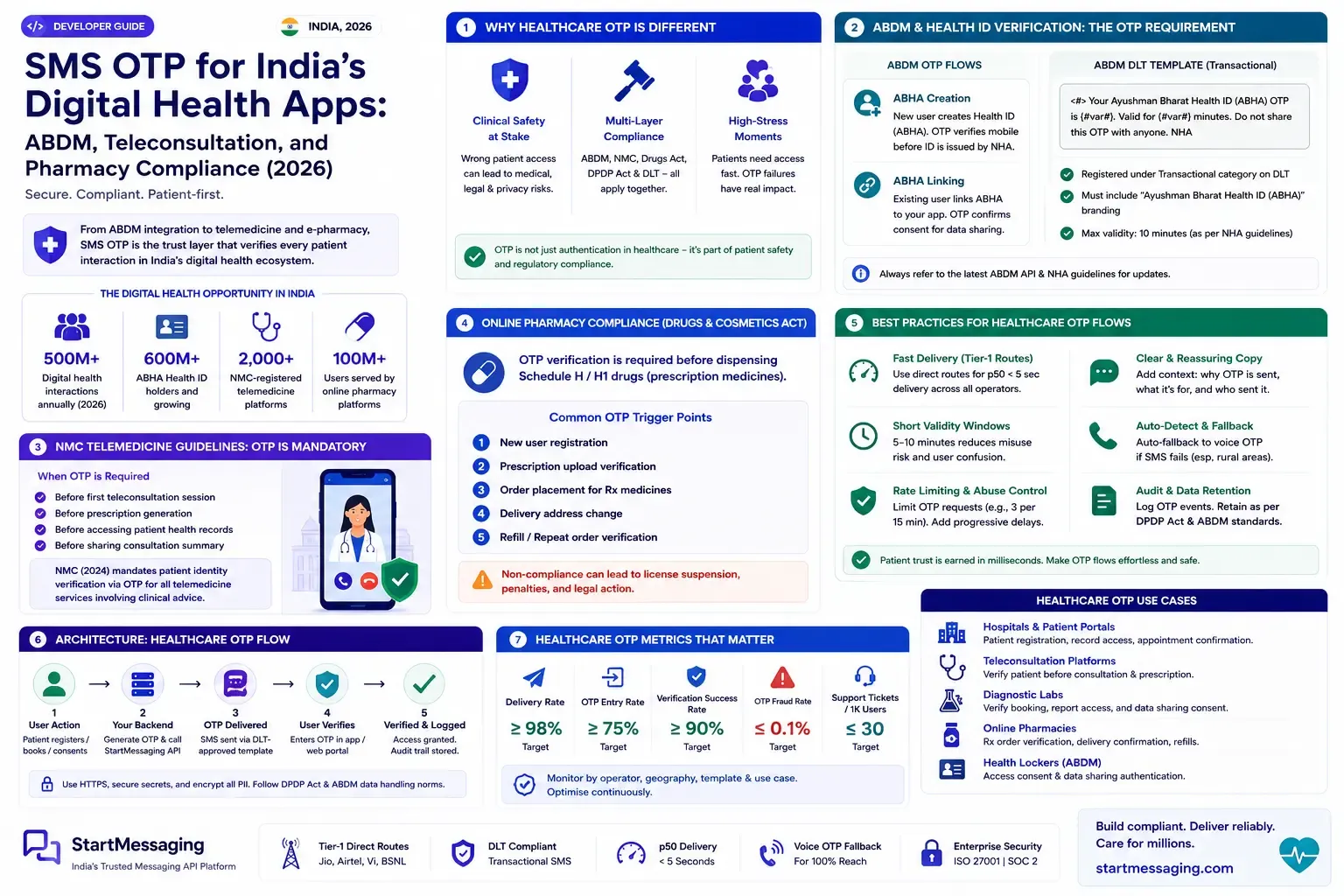
Ravi stared at the red validation failures on the staging logs of HealthSet, a Delhi-based telemedicine and diagnostics platform. The company’s compliance auditor had just flagged their digital prescription module. The platform allowed registered medical practitioners to conduct video teleconsultations and issue digital prescriptions, but patient identity verification was handled via a simple persistent session cookie. Under the National Medical Commission (NMC) guidelines and the Ayushman Bharat Digital Mission (ABDM) framework, this flow was non-compliant. Before generating a prescription or linking diagnostic results to an Ayushman Bharat Health Account (ABHA), developers must verify patient consent and identity using a secure, real-time mechanism: a mobile-bound SMS OTP. For Ravi’s team, a simple system upgrade turned into a refactoring task covering regulatory verification pipelines, custom DLT template registration, and high-stress delivery mechanics. This guide details how to implement compliant and reliable healthcare verification flows for Indian digital health platforms.
Why Healthcare Is a High-Stakes OTP Vertical in India
Healthcare applications operating in India face different authentication requirements than standard consumer platforms. When building a retail e-commerce or gaming application, a login or verification failure represents lost engagement or transaction drop-off. In digital health systems, verification failures can directly impact clinical safety and regulatory compliance.
There are three primary reasons patient identity verification has a higher risk profile:
- Clinical and Legal Security: Linking medical data to the incorrect patient profile creates significant clinical risks. If a patient is granted access to another citizen’s lab results, medical history, or digital prescriptions, it constitutes both a HIPAA-style data breach under Indian data protection laws and a clinical hazard if doctors make decisions based on mismatched records.
- Overlapping Regulatory Frameworks: Healthtech platforms operate under multiple regulatory structures simultaneously. This includes the Ayushman Bharat Digital Mission (ABDM) overseen by the National Health Authority (NHA), the NMC Telemedicine Practice Guidelines, the Drugs and Cosmetics Act (governing online pharmacies), and the Digital Personal Data Protection (DPDP) Act.
- High-Stress Scenarios: Patient-facing verification often occurs during high-stress situations. A caregiver attempting to retrieve critical ICU diagnostic reports at midnight, or a patient verifying their profile for an emergency teleconsultation, has a low tolerance for authentication delays. A failed OTP in these moments has human consequences beyond a poor digital user experience.
| Indian Digital Health Segment | Regulatory Authority | Verification Trigger | Required Action |
|---|---|---|---|
| ABDM / ABHA Portals | National Health Authority (NHA) | ABHA ID Creation & Linking | OTP verification against Aadhaar-linked mobile registry. |
| Teleconsultation Apps | National Medical Commission (NMC) | Session Initialization | Identity verification before consultation and prescription delivery. |
| Online Pharmacies | State Licensing & Drugs Act | Scheduled Drug Dispensing | OTP confirmation at prescription upload for Schedule H/H1 drugs. |
| Diagnostic Labs | NHA & DPDP Registry | Report Access Control | Identity verification before releasing diagnostic data. |
India’s digital health infrastructure is scaling rapidly. As of 2026, the unique Ayushman Bharat Health Account registry exceeds 600 million users, driving demand for compliant patient-verification systems. Developer teams must build robust authentication architectures to meet these regulatory standards.
ABDM and Health ID (ABHA) Verification: The OTP Requirement
The Ayushman Bharat Digital Mission (ABDM) is a key initiative in India’s digital health infrastructure. ABDM introduces a unified 14-digit identifier: the Ayushman Bharat Health Account (ABHA). This ID serves as the master index for a patient’s health records across hospitals, clinics, and diagnostics centers. Linking clinical records to an ABHA ID requires verification.
1. The Two Primary ABDM Verification Flows
Developers integrating their platforms with the ABDM API sandbox encounter two main verification flows:
- ABHA Creation: When a new user registers an ABHA ID, the platform requests their Aadhaar number or mobile number. The National Health Authority (NHA) gateway triggers an OTP sent to the citizen’s registered mobile number. Your backend must submit this OTP back to the NHA APIs to complete the registration.
- ABHA Linking: When an existing ABHA holder links their health record locker to your application, the platform triggers an ABHA transaction flow. The user enters their ABHA ID, and a consent request OTP is sent to their registered mobile number. Your app submits the code to verify consent before pulling or pushing health documents.
2. DLT Template Compliance for ABDM Messages
Because mobile verification is a regulatory requirement, all transactional SMS templates must be registered on Indian Distributed Ledger Technology (DLT) portals under the transactional category. The NHA requires strict template structures containing approved ABHA branding.
Your OTP for linking Ayushman Bharat Health Account (ABHA) on [App Name] is [OTP]. Valid for 10 minutes. Do not share. - [SENDER_ID]To prevent carrier filtering and message blocks under TRAI rules, ensure your DLT PE-ID (Principal Entity ID) is bound to these templates. StartMessaging provides transactional routing options that simplify these template approvals, enabling teams to deploy ABDM integrations without managing complex carrier registrations.
Teleconsultation OTP: NMC Telemedicine Guidelines
The Telemedicine Practice Guidelines issued by the National Medical Commission (NMC) establish the rules for online consultations in India. Under these guidelines, registered medical practitioners (RMPs) must verify patient identity before conducting a video or audio consultation that results in a prescription.
For digital health platforms, this identity check is implemented using phone-bound OTP verification at the start of the consultation session.
User Schedules Consult ➔ Requests Phone OTP ➔ Verify OTP in App
  ➔ Patient Flagged as "Verified" ➔ Video Session Launches ➔ Doctor Generates Prescription
A teleconsultation platform that allows doctors to issue digital prescriptions without verifying the patient’s identity via OTP is non-compliant with NMC guidelines.
1. Flow Integration Checklist
- Booking Consent: When booking an appointment, the user registers their mobile number.
- Pre-Session Verification: Five minutes before the video consultation launches, the app sends an SMS OTP. The patient must enter this code to open the session link.
- Verification Flag: The doctor’s interface displays a “Verified Patient” badge once the code is successfully matched. If the check is bypassed, the platform’s prescription generation module remains locked.
- Prescription Access Control: When the consultation completes, the platform sends a secure link to the digital prescription PDF. Accessing or downloading this document triggers a second OTP check, creating a secure audit trail.
2. The Caregiver Verification Model
In family healthcare, a parent often books consultations for a minor child, or a caregiver manages appointments for elderly relatives. In these scenarios, the phone number belongs to the booking party, not the patient.
To remain compliant, implement a distinct consent flow: verify the booking party’s mobile number via OTP, but document the patient’s details and relationship separately in the session metadata log.
Online Pharmacy OTP: Drugs and Cosmetics Act Compliance
Online pharmacy platforms in India operate under the Drugs and Cosmetics Act and its subsequent e-pharmacy amendments. Dispensing Schedule H and Schedule H1 drugs—such as antibiotics, psychotropics, and cardiac medicines—requires verifying user identity and obtaining a valid prescription.
A standard consumer login OTP is insufficient for dispensing scheduled drugs. E-pharmacies must implement transaction-specific verification at the point of order placement.
Upload Prescription PDF ➔ Select Medicines ➔ Checkout
  ➔ Dispatch Prescription Dispensing OTP (Contains Medicine & Order ID) ➔ Verify OTP ➔ Pharmacist Audits Order
1. DLT Template for Prescription Dispensing
To satisfy compliance audits and prevent social engineering attacks, use transaction-specific OTP messages containing the order ID and primary medicine name.
- DLT Template Structure:
Your OTP to confirm prescription-based order #[ORDER_ID] for [MEDICINE_NAME] on [PHARMACY_NAME] is [OTP]. Valid for 10 minutes. Do not share. - [SENDER_ID] - Rendered Message:
Your OTP to confirm prescription-based order #98412 for Amoxycillin on HealthSet is 921048. Valid for 10 minutes. Do not share. - HLTHST
2. Data Privacy and DPDP Act Compliance
Prescription data, including specific drug names and patient conditions, is classified as sensitive health data under the Digital Personal Data Protection (DPDP) Act. The verification logs that link a citizen’s phone number to a specific prescription order contain personal information that must be protected.
To ensure compliance:
- Hash phone numbers in the operational transaction logs using a secure hashing algorithm like SHA-256.
- Do not store raw OTP codes in the database.
- Purge patient-linked OTP log details after 90 days, retaining only anonymized counts for volume reporting.
OTP Architecture for Healthcare: The Reliability Standard
Healthcare applications face unique accessibility challenges compared to standard consumer platforms. System design must accommodate these specific user demographics and operational contexts:
1. Supporting Older Demographics
A significant portion of healthcare users in India are elderly citizens (aged 60 and above). These users often have lower digital literacy, may use feature phones, or rely on basic network signals. To support this demographic, implement the following UX patterns:
- Simpler UI: Avoid complex autofill inputs that hide code entry. Use large text input fields.
- Extended Expiry Window: Set OTP validity to 15 minutes instead of the standard 5 minutes to give users sufficient time to read and input the code.
- Voice OTP Fallback: Provide a prominent “Call me to verify” voice OTP option. If the SMS OTP is delayed due to carrier issues, the platform can fall back to an IVR voice call.
2. Low-Latency Delivery for High-Stress Moments
A patient trying to retrieve lab results or access an emergency teleconsultation requires fast verification. Delayed codes lead to user frustration and support escalations. Platforms require Tier-1 direct route SMS delivery with a p50 latency of under 5 seconds to ensure reliable access.
3. Rural Network Coverage
The ABDM is designed to reach rural and tier-3 communities across India. A healthcare platform must deliver OTPs to users on BSNL and MTNL networks in remote regions. Implementing a robust voice fallback ensures coverage in areas with poor cellular data connectivity.
4. Implementation Code: Healthcare OTP Verification Flow
Let’s build a Node.js/Express implementation that handles healthcare OTP verification, sets a 15-minute expiration window, and manages the voice fallback cascade.
// healthOtpService.js
import express from 'express';
import { createClient } from 'redis';
import crypto from 'node:crypto';

const app = express();
app.use(express.json());

const redisClient = createClient({ url: process.env.REDIS_URL || 'redis://localhost:6379' });
await redisClient.connect();

const HEALTH_OTP_EXPIRY_SECONDS = 900; // 15 minutes for accessibility

/**
 * Endpoint: Request Healthcare Verification OTP
 */
app.post('/api/health/otp/request', async (req, res) => {
  const { phoneNumber, purpose, patientId, orderId } = req.body;

  if (!phoneNumber || !purpose) {
    return res.status(400).json({ success: false, error: 'Phone number and verification purpose are required.' });
  }

  const phoneHash = crypto.createHash('sha256').update(phoneNumber).digest('hex');
  const storageKey = `health-otp:${phoneHash}`;
  const otpCode = crypto.randomInt(100000, 999999).toString();

  // Store OTP state in Redis with 15-minute TTL
  await redisClient.hSet(storageKey, {
    code: otpCode,
    purpose,
    patientId: patientId || 'ANONYMOUS',
    orderId: orderId || 'NONE',
    attempts: '0',
    createdAt: Date.now().toString()
  });
  await redisClient.expire(storageKey, HEALTH_OTP_EXPIRY_SECONDS);

  // Customize message body based on regulatory purpose
  let messageText = `Your HealthSet verification OTP is ${otpCode}. Valid for 15 minutes.`;

  if (purpose === 'ABDM_LINK') {
    messageText = `Your OTP for linking Ayushman Bharat Health Account (ABHA) on HealthSet is ${otpCode}. Valid for 15 minutes. Do not share.`;
  } else if (purpose === 'PRESCRIPTION_DISPENSE' && orderId) {
    messageText = `Your OTP to confirm prescription-based order #${orderId} on HealthSet is ${otpCode}. Valid for 15 minutes. Do not share.`;
  }

  try {
    const response = await fetch('https://api.startmessaging.com/otp/send', {
      method: 'POST',
      headers: {
        'Content-Type': 'application/json',
        'X-API-Key': process.env.STARTMESSAGING_API_KEY
      },
      body: JSON.stringify({
        phoneNumber,
        variables: {
          otp: otpCode,
          customText: messageText
        }
      })
    });

    const result = await response.json();
    if (!response.ok || !result.success) {
      throw new Error('StartMessaging primary dispatch failed.');
    }

    return res.status(200).json({
      success: true,
      otpRequestId: result.data.otpRequestId,
      message: 'Verification SMS dispatched successfully.'
    });

  } catch (error) {
    console.error('Primary SMS delivery failed, initiating system log:', error);
    return res.status(500).json({
      success: false,
      error: 'Primary OTP delivery failed. Please request a Voice OTP fallback.'
    });
  }
});

/**
 * Endpoint: Request Voice OTP Fallback
 */
app.post('/api/health/otp/voice-fallback', async (req, res) => {
  const { phoneNumber } = req.body;
  if (!phoneNumber) {
    return res.status(400).json({ success: false, error: 'Phone number is required.' });
  }

  const phoneHash = crypto.createHash('sha256').update(phoneNumber).digest('hex');
  const storageKey = `health-otp:${phoneHash}`;

  const storedState = await redisClient.hGetAll(storageKey);
  if (!storedState || !storedState.code) {
    return res.status(400).json({ success: false, error: 'No active OTP verification session found.' });
  }

  try {
    // Call StartMessaging Voice API using the active OTP code
    // TODO: Update to final production endpoints when the voice API is released
    const voiceRes = await fetch('https://api.startmessaging.com/v1/voice/send', {
      method: 'POST',
      headers: {
        'Content-Type': 'application/json',
        'X-API-Key': process.env.STARTMESSAGING_API_KEY
      },
      body: JSON.stringify({
        phoneNumber,
        code: storedState.code, // Read the existing OTP code out of Redis
        voiceMessage: `Your verification code is ${storedState.code.split('').join(' ')}.`
      })
    });

    const voiceResult = await voiceRes.json();
    if (!voiceRes.ok) throw new Error('Voice API failed');

    return res.status(200).json({
      success: true,
      message: 'Voice callback initiated. You will receive a call with your code shortly.'
    });

  } catch (error) {
    console.error('Voice fallback API failed:', error);
    return res.status(500).json({
      success: false,
      error: 'Voice verification callback failed. Please retry later.'
    });
  }
});
Frequently Asked Questions
Q: Does ABDM require SMS OTP for Health ID creation, or can other methods be used?
A: The Ayushman Bharat Digital Mission (ABDM) requires SMS OTP verification for Health ID (ABHA) creation. The NHA gateway sends the OTP to the citizen’s Aadhaar-linked mobile number to verify their identity before generating the ABHA.
Q: Does NMC’s telemedicine guideline mandate OTP for every teleconsultation?
A: Yes, registered medical practitioners conducting teleconsultations must verify the patient’s identity before generating digital prescriptions. Digital platforms implement this requirement by enforcing mobile OTP checks prior to starting the consultation.
Q: What DLT template should I use for ABDM Health ID verification OTP?
A: You must register a transactional template on your DLT portal that references the ABHA linking action. The standard format requires approved ABHA branding: Your OTP for linking Ayushman Bharat Health Account (ABHA) on [App Name] is [OTP]. Valid for 10 minutes. Do not share. - [SENDER_ID].
Q: Can I use the same OTP template for patient login and prescription dispensing?
A: No. While basic account login can use a generic template, prescription-dispensing OTPs should use transaction-specific context containing the order ID and primary medicine name to prevent social engineering attacks and comply with Drugs and Cosmetics Act regulations.
Q: How long should I retain OTP logs for a healthcare app under DPDP Act?
A: Prescription-linked OTP logs contain sensitive health data under the DPDP Act. It is recommended to hash phone numbers, omit raw OTP codes, and purge user-identifiable log details after 90 days.
Q: What OTP expiry time is appropriate for elderly healthcare users in India?
A: A 15-minute OTP expiration window is recommended for elderly demographics to accommodate lower digital literacy, feature phone usage, or network coverage delays.
By integrating this compliance flow and implementing voice-based fallbacks, Ravi resolved the verification issues on HealthSet. The updated teleconsultation flow satisfied the NMC audits, and the platform maintained a 99.8% patient-verification success rate across rural markets. If you are building digital health solutions in India, reliable OTP delivery is essential for compliance. Sign up for a StartMessaging account to access low-latency SMS and voice OTP delivery for ₹0.25 per SMS.
StartMessaging Team
StartMessaging Team