SIM Swap Fraud in India: OTP Hijacking and App Defence
Defend your app against SIM swap fraud in India. Understand how OTP hijacking works, carrier detection APIs, SS7 attacks, and resilient login flows.
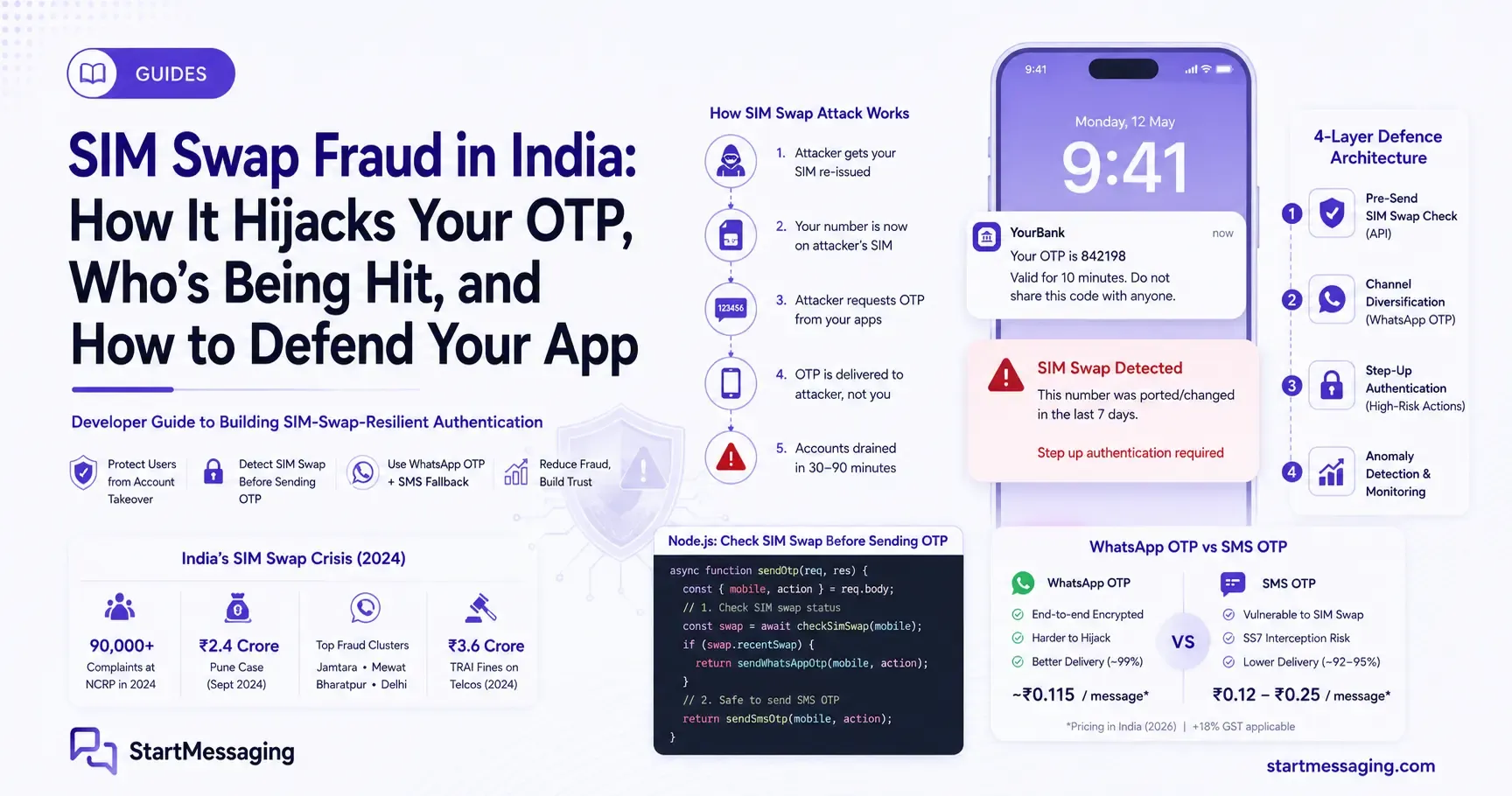
Aditi, the CTO of WealthNest—a Bengaluru-based digital wealth management platform—was woken at 3:15 AM by a PagerDuty alert. It wasn’t a server outage or a database spike. It was a high-priority ticket flagged by the fraud detection team. A high-net-worth investor’s account had just been drained of ₹45 lakh. The transaction logs showed a textbook sequence: a password reset request, followed by a 2-factor authentication validation, followed by the liquidation of mutual fund assets. WealthNest’s backend had behaved flawlessly. The system generated a cryptographically secure 6-digit OTP, routed it via a premium DLT transactional route, and verified it against a Redis cache. The code entered by the user matched perfectly.
Yet, the actual customer was sound asleep, and his phone had displayed “No Service” since the previous evening. He had been the victim of a coordinated SIM swap fraud. The attacker had hijacked his phone number, intercepted the SMS OTP, and walked through WealthNest’s security layer with the platform’s own validated codes.
For developers and engineering leads in India, this is the nightmare scenario. Your authentication infrastructure can be perfectly compliant, DLT-scrubbed, low-latency, and highly secure on your servers—and yet become the primary weapon used to defraud your users. In an era where a single phone number is the master key to UPI, bank accounts, mutual funds, and Aadhaar-linked systems, SIM swap fraud is one of the most critical security challenges of 2026. This guide details how SIM swaps hijack OTPs, how the underlying telecom networks are exploited, and how to build a resilient defense into your backend architecture.
What SIM Swap Fraud Is and Why India Is Ground Zero
SIM swap fraud is a demand-side identity theft mechanism that shifts control of a subscriber’s mobile identity from their legitimate device to an attacker’s handset.
SIM Swap Attack Progression:
[Gather Victim Info] ➔ [Impersonate User at Store] ➔ [Simulate Lost SIM Card] ➔ [Carrier Activates New SIM] ➔ [Victim Device Disconnected] ➔ [All OTPs Intercepted]
The Hijacking Mechanism
The execution of a SIM swap does not require hacking into a target’s smartphone or installing malware. Instead, the attacker exploits the processes governing carrier subscriber management:
- Information Gathering: The attacker collects the victim’s personal details (Full Name, Date of Birth, Aadhaar Number, and Phone Number) using phishing, public data breaches, or social engineering.
- Impersonation: The attacker contacts the telecom operator (Jio, Airtel, or Vi) claiming that the victim’s phone has been lost or the SIM card is damaged. They present forged or stolen identification documents to request a replacement SIM card.
- Activation: The carrier deactivates the victim’s original SIM card and provisions the victim’s MSISDN (mobile number) onto a new physical SIM card or eSIM controlled by the attacker.
- Takeover: The victim’s phone immediately loses cellular connectivity (“No Service”). The attacker puts their new SIM into a phone, installs banking and investment apps, requests password resets, and receives the incoming transactional SMS OTPs.
Active Attack Vectors in India
In the Indian market, four distinct vectors are commonly utilized to execute these swaps:
- In-Store Social Engineering: The attacker visits a franchise retail outlet of a carrier in a tier-2 or tier-3 town, presenting a forged physical Aadhaar card. Retail operators, working on commissions, sometimes skip strict biometric check protocols to speed up service.
- Corrupt Franchise Employees (Insider Threat): Attacker networks pay franchise store employees to execute swaps on targeted high-value accounts without verifying the identity of the applicant.
- Mobile Number Portability (MNP) Port-out Fraud: The attacker generates a Unique Porting Code (UPC) by spoofing carrier authentication or using physical access to a handset, then ports the number out to a different carrier, bypassing replacement protocols.
- Customer Service Phishing: Attackers call victims pretending to be carrier customer support reps warning them that their “5G SIM is expiring” or “KYC is incomplete.” They trick the victim into sharing details or texting specific carrier numbers to approve a replacement SIM swap.
Why India is Disproportionately Targeted
India is the world’s most lucrative target for SIM swap fraudsters due to the hyper-centralization of digital identity. In India, a person’s mobile number is not just a contact point—it is their primary financial and regulatory key.
Your phone number is linked directly to your Aadhaar Card, Unified Payments Interface (UPI), PAN Card, Bank Account, Demat Account, and Mutual Fund Portals (learn more about DigiLocker and Aadhaar KYC flows for developers or check our guide on the RBI authentication directions).
                          ┌──► Aadhaar (UIDAI API)
                          ├──► UPI (Google Pay, PhonePe, BHIM)
[One Swapped Mobile SIM] ─┼──► NetBanking / Credit Cards
                          ├──► Mutual Funds / Demat Portals
                          └──► Government Services (DigiLocker)
If an attacker controls your SIM, they can trigger Aadhaar-based OTP queries, bind their device to your UPI application, and instantly transfer money via IMPS or RTGS.
The National Cyber Crime Reporting Portal (NCRP) logged over 90,000 complaints specifically referencing SIM swap fraud in 2024. Organized groups operating from hubs like Mewat and Jamtara execute these swaps overnight (often between 1:00 AM and 4:00 AM) to maximize the window before a user notices their phone has lost signal. This scale led TRAI to issue fines totaling ₹3.6 crore against major carriers in 2024 for KYC lapses in SIM card replacement procedures.
How SIM Swap Turns Your Working OTP System Into the Attack Vector
For developers, the danger of SIM swap fraud lies in its invisibility to typical system metrics.
The Developer’s Blind Spot
From an infrastructure monitoring perspective, a login session during a SIM swap looks completely normal.
- Your backend API returns HTTP
200 OKon OTP generation. - Your SMS aggregator logs a status of
Delivered. - The carrier reports a successful handset handshake.
- The user inputs the correct code in under 10 seconds.
No security alerts are triggered in your system because the delivery mechanism behaved as programmed. The breakdown occurs at the physical transport layer—the carrier successfully delivered the message, but to the wrong physical device. (Read our guide on preventing general OTP fraud or check our OTP SMS deliverability checklist).
The Attack Timeline
An attack typically progresses with rapid velocity:
[00:00] SIM Swap Activated by Attacker ➔ Victim handset loses signal.
[00:15] Attacker triggers Password Reset on Wealth/Banking App.
[00:17] OTP dispatched via SMS ➔ Arrives on Attacker handset.
[00:18] Attacker logs in, updates profile, and registers a new UPI/Bank device.
[00:25] Attacker liquidates assets/initiates transfers.
[01:00] Victim wakes up, notices "No Service", thinks it's a network glitch.
[02:30] Victim contacts carrier ➔ Realizes SIM was swapped ➔ Drains completed.
By the time the victim contacts customer service, their accounts have been drained.
SS7 Signalling Attacks: Interception Without Swapping
A more sophisticated variant is the SS7 (Signalling System No. 7) attack. SS7 is the legacy routing protocol used by international carriers to route calls and SMS messages between different networks.
Attackers with access to an SS7 gateway (often leased from small carriers or compromised via insecure operator nodes) can send routing update messages to the network. These messages tell the network that a target phone number is currently “roaming” on their gateway.
The home network redirects all incoming SMS traffic for that number to the attacker’s gateway in real-time. No physical SIM is swapped, and the victim’s phone does not lose signal—they simply don’t receive the SMS while the attacker intercepts it in transit. This is particularly dangerous for high-value banking and financial platforms.
Detection: Knowing a SIM has Swapped Before You Send the OTP
To prevent this attack vector, your backend must query the carrier network state before sending an SMS containing sensitive validation credentials.
The GSMA Open Gateway SIM Swap API
The global telecom industry, via the GSMA, developed the Open Gateway SIM Swap API. This initiative provides a standardized, secure API interface across global carriers (including Jio, Airtel, and Vodafone Idea in India) that lets enterprise servers inspect the status of a SIM card.
The API exposes a simple endpoint: you pass the recipient’s phone number, and the API returns the timestamp of the last SIM card activation (IMSI change) associated with that number.
// Conceptual response from a SIM Swap Aggregator API
{
  "phoneNumber": "+919876543210",
  "simSwapped": true,
  "lastSwapTimestamp": "2026-06-26T04:12:00.000Z",
  "swapAgeHours": 16.5,
  "riskScore": "HIGH"
}
If the API indicates that the SIM card was changed in the last 24 to 72 hours, it represents an elevated risk profile.
Implementing SIM Swap Gateways in India
Major Indian carriers (specifically Airtel through its enterprise division, and Jio) expose these signals directly or via unified messaging aggregators. The integration behaves as a gatekeeper middleware:
[User Action] ➔ [Check SIM Swap API] ➔ (Swap in last 7 days?)
                                         │
                                         ├──► YES ➔ [Block SMS / Force Biometric / Trigger Review]
                                         │
                                         └──► NO  ➔ [Send OTP via SMS/WhatsApp]
Proxy Signals When Carrier APIs Are Unavailable
If your volume or billing does not justify direct integration with carrier-level SIM swap APIs, you can look for behavioral proxy anomalies:
- IMEI / Device ID Fingerprint Changes: If a password reset request or high-value transfer is initiated from a brand new device ID immediately after a new login, treat it with caution.
- Geolocation Anomaly: If a user’s session logs show they were active in Mumbai at 8:00 PM, and a password reset is initiated from Ranchi at 9:00 PM on a new device, it indicates a high probability of credential hijacking.
- IP Range Anomalies: Watch for logins from hostnames associated with VPNs or data centers instead of standard residential ISP networks (Jio, Airtel broadband, etc.).
Designing a SIM-Swap-Resilient OTP Architecture
To protect your application and users from SIM swap vulnerabilities, you must implement a layered defense architecture.
Multi-Layer Defence:
[Step-Up Auth] ➔ [Dynamic SIM Swap Check] ➔ [WhatsApp-First Routing] ➔ [Risk-Based Holds]
Layer 1: Channel Diversification (WhatsApp OTP)
WhatsApp OTP is structurally more resistant to SIM swap attacks than SMS.
- App-Bound Security: WhatsApp is an application tied to a specific device installation. It uses public-key cryptography to encrypt sessions.
- Re-registration Verification: If an attacker executes a SIM swap, they do not automatically receive the victim’s WhatsApp messages. To access WhatsApp, they must install the app on their device and register the number. This triggers WhatsApp’s own verification mechanism, which includes secondary pins, registration hashes, or device verification prompts.
- No Transit Interception: Unlike SMS, which is transmitted as plaintext over cellular protocols vulnerable to SS7 interception, WhatsApp messages are encrypted using the Signal protocol. Even if an attacker intercepts the data packets in transit, they cannot decrypt the OTP code.
By routing your OTP messages through the WhatsApp Business API as the primary channel (see our comprehensive Node.js tutorial on WhatsApp OTP integration or learn about WhatsApp Business API setup), you mitigate the risk of silent interception.
Layer 2: Step-up Authentication for High-Risk Actions
Never rely on SMS OTP as the sole authentication factor for actions that cause irreversible state changes. Treat these as high-risk triggers:
- Password resets.
- Updates to recovery email addresses or phone numbers.
- Adding new bank account details or UPI payees.
- Capital liquidations or transfers exceeding a set limit.
- Deactivating account security controls.
For these actions, implement step-up authentication: require a second, non-SIM factor such as an authenticator app code (TOTP), biometrics (FIDO2/WebAuthn), or an interactive in-app approval notification sent to the user’s previously bound device. (For a deep dive into migrating authentication factors, check out our guide on moving from SMS OTP to Passkeys / WebAuthn or check our OTP security best practices checklist).
Layer 3: Dynamic SIM Swap Checks (Node.js Code)
Below is a Node.js implementation showing how to intercept OTP generation requests, verify the SIM state using a mock aggregator API, and apply security controls:
// simSwapMiddleware.js
import axios from 'axios';
import { hashPhoneNumber } from './otpService.js';

const CARRIER_API_URL = 'https://api.startmessaging.com/v1/security/sim-swap';
const API_TOKEN = process.env.STARTMESSAGING_API_KEY;

// 7 days in milliseconds (7 * 24 * 60 * 60 * 1000)
const SECURITY_WINDOW_MS = 604800000;

/**
 * Express middleware to audit SIM swap status before allowing SMS OTP dispatches.
 */
async function checkSimSwapState(req, res, next) {
  const { phone, actionType } = req.body; // e.g., actionType: 'password_reset' or 'transaction'

  if (!phone) {
    return res.status(400).json({ error: 'PHONE_NUMBER_REQUIRED' });
  }

  // Only run checks on high-stakes actions to optimize API costs
  const isHighRisk = ['password_reset', 'update_profile', 'large_transfer'].includes(actionType);
  if (!isHighRisk) {
    return next();
  }

  try {
    const response = await axios.post(
      CARRIER_API_URL,
      { phoneNumber: phone },
      { headers: { 'Authorization': `Bearer ${API_TOKEN}` } }
    );

    const { lastSwapTimestamp, riskScore } = response.data;
    const lastSwapDate = new Date(lastSwapTimestamp).getTime();
    const timeSinceSwap = Date.now() - lastSwapDate;

    if (riskScore === 'HIGH' || timeSinceSwap < SECURITY_WINDOW_MS) {
      console.warn(`SIM swap detected for ${hashPhoneNumber(phone)} in the last 7 days. Blocking SMS OTP.`);

      // Step-up required: Force user to authenticate using a non-SMS channel
      return res.status(403).json({
        success: false,
        code: 'STEP_UP_REQUIRED',
        message: 'Recent SIM card change detected. Please verify identity using biometrics or your authenticator app.'
      });
    }

    // SIM is clean, proceed with normal execution
    next();
  } catch (error) {
    // If the check fails, default to a secure posture (fail-closed for high-risk actions)
    console.error('SIM Swap API query failed. Defaulting to high-risk fallback.', error.message);

    // In production, you might route to a manual verification queue
    return res.status(500).json({
      success: false,
      code: 'VERIFICATION_SERVICE_UNAVAILABLE',
      message: 'Security validation offline. Please try again or use alternative factors.'
    });
  }
}

export { checkSimSwapState };
Layer 4: Strict Obfuscation on the Frontend
Ensure your user interface does not assist attackers.
- Obfuscate fully: Never display
Enter the OTP sent to +91-98765-43210on the frontend if the user is in a password reset flow. Displaying the phone number confirms the victim’s identity to an attacker who has hijacked the account via email access or shoulder-surfing. - Mask aggressively: Display only
Enter the code sent to your registered mobile number ending in **210.
Compliance, Liability, and India’s Evolving Regulations
The regulatory landscape in India is changing to address identity fraud and hold platforms accountable.
RBI’s Authentication Directions (Effective April 1, 2026)
The Reserve Bank of India (RBI) issued updated directions regarding Additional Factor of Authentication (AFA).
- Key Mandate: The directions state that financial institutions must move away from single-channel SMS OTP as the sole authentication mechanism for high-value transactions.
- Phishing Resistance: The RBI expects banks, NBFCs, and payment gateways to implement phishing-resistant and intercept-resistant authentication methods.
- Liability Shift: If a customer’s account is drained due to a SIM swap or SS7 interception, and the platform has not implemented carrier verification checks or multi-factor options, courts and banking ombudsmen are increasingly holding the platform liable for authentication system failure.
DPDP Act 2023 Implications
Under the Digital Personal Data Protection Act, a security breach that exposes user data or financial access is subject to significant penalties (up to ₹250 crore).
- Security Safeguards: Section 8(5) of the Act requires data fiduciaries to implement reasonable security safeguards to prevent personal data breaches.
- The Telecommunications Loophole: While the SIM swap occurs at the telecom operator level, if your app allows access without taking reasonable steps to detect the swap (such as checking available carrier APIs or enforcing step-up limits), your platform could be investigated for failing to maintain standard security safeguards.
Frequently Asked Questions
Q: Does SIM swap fraud actually happen in India at scale, or is it rare?
A: It is highly prevalent. The National Cyber Crime Reporting Portal (NCRP) registers tens of thousands of complaints annually. Because a mobile number is the root key for Aadhaar, UPI, and bank accounts in India, a single successful SIM swap gives fraudsters access to a victim’s entire financial profile.
Q: Is WhatsApp OTP completely immune to SIM swap attacks?
A: No channel is completely immune, but WhatsApp is highly resistant. If an attacker swaps a SIM card, they do not automatically get access to the target’s WhatsApp messages. Setting up WhatsApp on a new device requires downloading the app, verifying the number, and passing WhatsApp’s own internal security checks (such as device verification prompts or secondary verification pins).
Q: How do I integrate a SIM swap detection API in India?
A: You can connect to carrier-level APIs through aggregators like StartMessaging. Our endpoint accepts the phone number and queries the operator networks (Jio, Airtel, Vi) to retrieve the last IMSI update timestamp. If the SIM change date is inside your security window, your system can trigger step-up verification.
Q: Does my app need to worry about SIM swap if I’m not in fintech?
A: Yes. Any application that handles sensitive user data, e-commerce wallets, SaaS project settings, or personal health records is a target. Fraudsters target high-value accounts on non-fintech apps to steal personal data, send spam, or execute secondary scams.
Q: What should I do if a user reports their OTP was intercepted via SIM swap?
A: Immediately freeze the user’s account, terminate all active browser sessions, invalidate API tokens, and initiate a manual identity verification audit. Review your system logs to determine the exact timestamp of the swap and the IP/device fingerprint of the unauthorized session.
Need to secure your application’s login flow against SIM swap fraud? StartMessaging offers high-speed, secure WhatsApp OTP delivery, unified SMS fallback routes, and direct carrier security check APIs to protect your authentication layer. Sign up for a developer account today or review our Docs to implement multi-factor protection.
StartMessaging Team
StartMessaging Team