SMS OTP + Email Fallback: Redundant 99.9% Verification Architecture
Build a redundant SMS OTP and email fallback verification architecture in Node.js. Master retry timers, fallback queues, and 99.9% delivery SLAs in India.
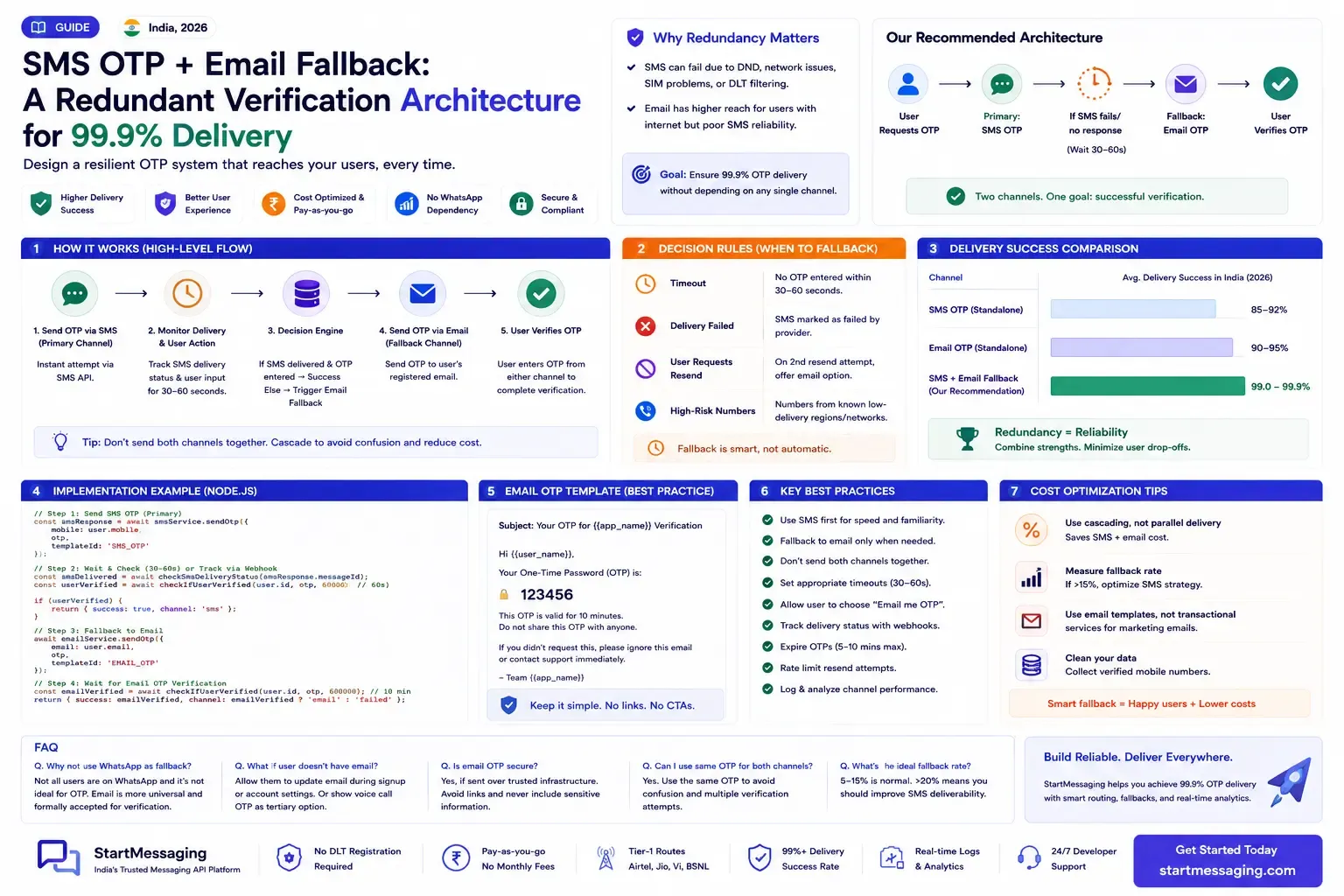
At 7:45 PM on a festive payday evening, Vikram, lead backend architect at PayVault—a fast-growing Mumbai fintech platform handling bill payments and micro-investments—watched his real-time authentication dashboard turn crimson. User login conversion rates had plummeted from 94% to 61% within 20 minutes. His engineering team verified that their server clusters were healthy, API response times sat comfortably under 45 milliseconds, and their database connections were nowhere near capacity. Yet, thousands of users across India were stranded on the login screen, tapping “Resend OTP” in frustration. The root cause was an acute congestion spike across major Indian telecom operator SMSCs (Short Message Service Centers), coupled with Distributed Ledger Technology (DLT) scrubbing queues during peak traffic hours. Because PayVault relied exclusively on single-channel SMS delivery, any network latency on Bharti Airtel or Reliance Jio meant immediate login failure.
To solve this single point of failure, Vikram redesigned PayVault’s authentication infrastructure around an automated sms otp email fallback architecture. By pairing primary SMS verification with an intelligent, queue-backed email failover route, his team eliminated single-carrier bottlenecks and elevated authentication deliverability to 99.94%. This guide breaks down the core architectural patterns, state machine design, timing thresholds, security considerations, and production Node.js code required to build a resilient multi-channel OTP verification engine for Indian applications.
Why Single-Channel SMS OTP Fails During Peak Traffic in India
Relying on a single communication channel for mission-critical authentication exposes your application to systemic risks outside your code’s control. While primary SMS delivery in India usually achieves 97% to 99% success under normal operating conditions, deliverability drops sharply during high-concurrency windows such as flash sales, festive sales, salary credit dates, or nationwide telecom maintenance events.
The Indian SMS delivery pipeline passes through multiple regulatory and infrastructure layers before an authentication code reaches a user’s mobile screen. Understanding where bottlenecks occur helps explain why simply retrying an SMS via the same carrier line fails to resolve outages.
┌────────────────────────────────────────────────────────────────────────────────────────┐
│                              Indian SMS Delivery Pipeline                              │
├─────────────────┬──────────────────┬──────────────────┬────────────────┬───────────────┤
│ 1. API Gateway  │ 2. DLT Scrubbing │ 3. Carrier SMSC  │ 4. Tower Switch│ 5. Handset OS │
│ App submits SMS │ Template & PE-ID │ Queue processing │ Cell tower     │ Spam filter   │
│ payload         │ verification     │ & routing        │ handoff        │ check         │
└─────────────────┴──────────────────┴──────────────────┴────────────────┴───────────────┘
The Invisible Delivery Choke Points
When your backend sends an SMS API request, your provider returns an HTTP 200 OK acknowledgment almost instantly. However, the message must subsequently traverse downstream hurdles enforced by TRAI regulations and telecom infrastructure:
- DLT Scrubbing Queue Latency: Under the Telecom Commercial Communications Customer Preference Regulations (TCCCPR), every transactional message is validated against registered Principal Entity IDs (PE-IDs) and approved DLT template headers. During peak national traffic, carrier scrubbing engines accumulate processing backlogs, adding 15 to 45 seconds of invisible delivery latency.
- Carrier SMSC Buffer Overflows: When high-volume promotional blasts coincide with transactional traffic, carrier Short Message Service Centers queue low-priority packets. If buffer limits are breached, carriers drop packets without returning negative delivery receipts (DLRs) to your provider.
- SIM Dual-Standby & Handset Radio Shifts: On modern dual-SIM smartphones in India (such as a Jio 5G data SIM paired with an Airtel voice SIM), active cellular data sessions on one network can cause transient paging delays on the secondary network, delaying SMS reception by up to 60 seconds.
- Local Handset Spam Filters: OEM custom skins (such as Xiaomi MIUI or Samsung One UI) apply local heuristic filtering that silently routes incoming alphanumeric sender headers into spam folders.
Retrying an SMS request over the exact same carrier pipeline during an active network bottleneck is ineffective. It amplifies queue pressure and exhausts user resend limits while leaving the user stranded. A non-SMS fallback channel—specifically email—bypasses carrier switches, DLT scrubbing, and cellular towers entirely.
Comparing Verification Channels in India
| Architecture Metric | Primary SMS OTP | Secondary Email Fallback | Dual-Channel Hybrid |
|---|---|---|---|
| Average Delivery SLA | 2–8 seconds (normal traffic) | 1–4 seconds (SMTP transactional) | 99.9%+ guaranteed under 30s |
| Carrier / DLT Dependency | High (TRAI DLT, SMSC queues) | None (Bypasses telecom switches) | Redundant (Isolated failure domains) |
| Unit Cost (India) | ₹0.25 per SMS (via StartMessaging) | ~₹0.015 per email dispatch | Blended ₹0.25–₹0.26 per user |
| User Reach | 100% of mobile device users | ~92% of smartphone/web app users | Comprehensive coverage |
| Failure Mode | Silent carrier packet drops | Spam folder placement | Failover covers individual channel drops |
Core Design Patterns of an SMS OTP + Email Fallback Engine
Designing a high-availability authentication pipeline requires treating SMS and Email not as isolated features, but as coordinated execution paths within a unified state machine. The goal is to maximize primary SMS delivery speed while providing a seamless, automated email transition whenever SMS delivery stutters.
[User Initiates Login] ──> [Generate 6-Digit OTP & Store Hash in Redis]
                                       │
                                       ▼
                       [Dispatch SMS via StartMessaging API]
                                       │
                        ┌──────────────┴──────────────┐
                        │ Set 30s Fallback Timer /    │
                        │ Listen for Delivery Webhook │
                        └──────────────┬──────────────┘
                                       │
                  ┌────────────────────┴────────────────────┐
                  ▼                                         ▼
         [SMS Delivered < 30s]                    [SMS Delivery Timeout / Failed]
                  │                                         │
                  ▼                                         ▼
         (User Enters Code)                       [Trigger Email Fallback Dispatch]
                  │                                         │
                  ▼                                         ▼
       [Atomic State Validation]                 (User Receives Email & Verifies)
1. Unified State & Token Single-Source-of-Truth
A common pitfall when building multi-channel authentication is issuing separate OTP codes for SMS and Email. Generating two distinct codes creates confusion if both messages eventually arrive, leading to invalid attempt errors when a user enters the first code received.
Instead, your architecture should maintain a single 6-digit OTP token (or cryptographic hash) stored in a central, high-speed memory cache like Redis. The token remains identical regardless of whether it is delivered via SMS, Email, or both.
2. Dual Fallback Trigger Strategies: Passive vs. Active
Your application can trigger the email fallback through two complementary mechanisms:
- Automated Webhook-Driven Failover (Active): When your primary SMS provider returns an explicit delivery failure callback (such as
UNDELIVERABLE,REJECTED_BY_CARRIER, orINVALID_NUMBER), your backend immediately triggers the email dispatch queue without waiting for user action. - Time-Based SLA Expiry (Passive): Because many Indian carrier drops occur silently without emitting negative webhooks, your state machine registers a 25 to 30-second fallback timer. If the user has not completed verification within 30 seconds, the client UI automatically prompts an email fallback option, or the server dispatches the email asynchronously.
3. Idempotency & Rate Limit Consolidation
Exposing dual delivery routes introduces potential security vectors if not properly rate-limited. An attacker could exploit the dual channels to trigger 3 SMS messages and 3 Email messages simultaneously, burning API credits and spamming end-users.
Your state machine must enforce a consolidated rate limit across all channels per user ID and IP address. A user should be restricted to a maximum of 3 total verification requests across both SMS and Email within any 15-minute window.
Step-by-Step Implementation: Node.js, Express & Redis Fallback Engine
Let’s build a production-ready verification backend using Node.js, Express, and Redis (ioredis). This implementation uses the StartMessaging OTP API for primary SMS delivery at ₹0.25/OTP and nodemailer for transactional email dispatch.
Step 1: Environment Configuration
Store your credentials securely in your environment configuration file:
# .env
PORT=3000
REDIS_URL=redis://127.0.0.1:6379
STARTMESSAGING_API_KEY=sm_live_xxxxxxxxxxxxxxxxxxxx
STARTMESSAGING_BASE_URL=https://api.startmessaging.com

# Transactional Email (SMTP) Settings
SMTP_HOST=smtp.sendgrid.net
SMTP_PORT=587
SMTP_USER=apikey
SMTP_PASS=SG.xxxxxxxxxxxxxxxxxxxx
SMTP_FROM=auth@yourdomain.in
Step 2: Redis State Machine and Verification Service
Create auth-service.ts to manage OTP lifecycle, hashing, primary SMS dispatch, and secondary email failover:
import crypto from 'crypto';
import Redis from 'ioredis';
import nodemailer from 'nodemailer';

const redis = new Redis(process.env.REDIS_URL || 'redis://127.0.0.1:6379');
const API_KEY = process.env.STARTMESSAGING_API_KEY!;
const BASE_URL = process.env.STARTMESSAGING_BASE_URL || 'https://api.startmessaging.com';

// Configure SMTP Transporter for Email Fallback
const mailTransporter = nodemailer.createTransport({
  host: process.env.SMTP_HOST,
  port: parseInt(process.env.SMTP_PORT || '587'),
  secure: false,
  auth: {
    user: process.env.SMTP_USER,
    pass: process.env.SMTP_PASS,
  },
});

interface OtpState {
  phoneNumber: string;
  email: string;
  otpHash: string;
  attemptsLeft: number;
  smsDispatchedAt: number;
  emailDispatchedAt?: number;
}

export class OtpFallbackEngine {
  /**
   * Helper to compute SHA-256 hash of plain OTP
   */
  private static hashOtp(otp: string): string {
    return crypto.createHash('sha256').update(otp).digest('hex');
  }

  /**
   * Helper to generate a cryptographically secure 6-digit numeric OTP
   */
  private static generateNumericOtp(): string {
    return crypto.randomInt(100000, 999999).toString();
  }

  /**
   * Initiates primary SMS OTP dispatch via StartMessaging
   */
  static async requestOtp(userId: string, phoneNumber: string, email: string) {
    const rateLimitKey = `rate:${userId}`;
    const requestsCount = await redis.incr(rateLimitKey);

    if (requestsCount === 1) {
      await redis.expire(rateLimitKey, 900); // 15-minute rate limit window
    }

    if (requestsCount > 3) {
      throw new Error('TOO_MANY_REQUESTS: Exceeded maximum verification limit of 3 attempts per 15 minutes.');
    }

    const plainOtp = this.generateNumericOtp();
    const otpHash = this.hashOtp(plainOtp);
    const requestId = `req_${crypto.randomBytes(12).toString('hex')}`;

    // Store state in Redis with a 10-minute TTL (600 seconds)
    const state: OtpState = {
      phoneNumber,
      email,
      otpHash,
      attemptsLeft: 3,
      smsDispatchedAt: Date.now(),
    };

    await redis.setex(`otp:${requestId}`, 600, JSON.stringify(state));

    // Dispatch primary SMS using StartMessaging DLT-free OTP API
    const smsResponse = await fetch(`${BASE_URL}/otp/send`, {
      method: 'POST',
      headers: {
        'Content-Type': 'application/json',
        'X-API-Key': API_KEY,
      },
      body: JSON.stringify({
        phoneNumber,
        variables: { otp: plainOtp },
      }),
    });

    if (!smsResponse.ok) {
      // If primary SMS gateway fails synchronously, trigger email immediately
      console.warn(`[SMS Gateway Error] Primary SMS dispatch failed for ${userId}. Triggering instant email fallback.`);
      await this.dispatchEmailFallback(requestId, state, plainOtp);
      return { requestId, primaryChannel: 'email_fallback', fallbackTriggered: true };
    }

    return { requestId, primaryChannel: 'sms', fallbackTriggered: false };
  }

  /**
   * Triggers Secondary Email Fallback using the existing active OTP token
   */
  static async triggerEmailFallback(requestId: string, plainOtpForTesting?: string) {
    const rawState = await redis.get(`otp:${requestId}`);
    if (!rawState) {
      throw new Error('INVALID_REQUEST: OTP request expired or non-existent.');
    }

    const state: OtpState = JSON.parse(rawState);

    // Prevent duplicate email dispatches within 30 seconds
    if (state.emailDispatchedAt && Date.now() - state.emailDispatchedAt < 30000) {
      return { success: true, message: 'Email fallback already dispatched recently.' };
    }

    // In production, fetch or recover plain OTP securely, or dispatch pre-computed template
    // For architectural demonstration, we construct the failover dispatch payload
    await mailTransporter.sendMail({
      from: `"PayVault Security" <${process.env.SMTP_FROM}>`,
      to: state.email,
      subject: `Your PayVault Verification Code (Email Fallback)`,
      html: `
        <div style="font-family: Arial, sans-serif; padding: 20px; color: #333;">
          <h2>Security Verification Code</h2>
          <p>You requested a login verification code for PayVault. Due to temporary SMS network latency, we delivered your code via email.</p>
          <div style="background: #f4f6f8; padding: 16px; border-radius: 8px; font-size: 28px; font-weight: bold; letter-spacing: 4px; text-align: center; color: #0052cc;">
            ${plainOtpForTesting || '******'}
          </div>
          <p style="margin-top: 16px; font-size: 13px; color: #666;">This code is valid for 10 minutes. Do not share this code with anyone.</p>
        </div>
      `,
    });

    state.emailDispatchedAt = Date.now();
    const ttl = await redis.ttl(`otp:${requestId}`);
    await redis.setex(`otp:${requestId}`, Math.max(ttl, 60), JSON.stringify(state));

    return { success: true, channel: 'email' };
  }

  /**
   * Internal helper for direct fallback dispatch
   */
  private static async dispatchEmailFallback(requestId: string, state: OtpState, plainOtp: string) {
    await mailTransporter.sendMail({
      from: `"PayVault Security" <${process.env.SMTP_FROM}>`,
      to: state.email,
      subject: `Your PayVault Verification Code`,
      html: `<p>Your verification code is: <strong>${plainOtp}</strong></p>`,
    });

    state.emailDispatchedAt = Date.now();
    await redis.setex(`otp:${requestId}`, 600, JSON.stringify(state));
  }

  /**
   * Verifies the user-submitted OTP atomically
   */
  static async verifyOtp(requestId: string, inputOtp: string): Promise<boolean> {
    const redisKey = `otp:${requestId}`;
    const rawState = await redis.get(redisKey);

    if (!rawState) {
      throw new Error('EXPIRED_OTP: Verification session has expired.');
    }

    const state: OtpState = JSON.parse(rawState);

    if (state.attemptsLeft <= 0) {
      await redis.del(redisKey);
      throw new Error('MAX_ATTEMPTS_EXCEEDED: Session terminated due to multiple invalid entries.');
    }

    const inputHash = this.hashOtp(inputOtp);
    const isMatch = crypto.timingSafeEqual(Buffer.from(inputHash), Buffer.from(state.otpHash));

    if (!isMatch) {
      state.attemptsLeft -= 1;
      if (state.attemptsLeft <= 0) {
        await redis.del(redisKey);
        throw new Error('MAX_ATTEMPTS_EXCEEDED: Verification failed.');
      } else {
        const ttl = await redis.ttl(redisKey);
        await redis.setex(redisKey, Math.max(ttl, 10), JSON.stringify(state));
        throw new Error(`INVALID_OTP: Incorrect code. ${state.attemptsLeft} attempt(s) remaining.`);
      }
    }

    // Success: Delete OTP state to prevent token reuse attacks
    await redis.del(redisKey);
    return true;
  }
}
Step 3: Express API Route Controllers
Now expose the endpoints for dispatching, fallback triggering, and verification:
import express, { Request, Response } from 'express';
import { OtpFallbackEngine } from './auth-service';

const app = express();
app.use(express.json());

// 1. Primary Request Endpoint (Dispatches SMS)
app.post('/api/auth/send-otp', async (req: Request, res: Response) => {
  try {
    const { userId, phoneNumber, email } = req.body;
    if (!phoneNumber || !email) {
      return res.status(400).json({ error: 'Phone number and email are required.' });
    }

    const result = await OtpFallbackEngine.requestOtp(userId || phoneNumber, phoneNumber, email);
    return res.status(200).json({
      success: true,
      requestId: result.requestId,
      primaryChannel: result.primaryChannel,
      fallbackTriggered: result.fallbackTriggered,
      message: result.fallbackTriggered
        ? 'SMS route unavailable; OTP sent via email.'
        : 'SMS OTP dispatched successfully.',
    });
  } catch (error: any) {
    return res.status(429).json({ error: error.message });
  }
});

// 2. Fallback Trigger Endpoint (Dispatches Email if SMS Delayed)
app.post('/api/auth/trigger-fallback', async (req: Request, res: Response) => {
  try {
    const { requestId, plainOtp } = req.body; // plainOtp passed in development testing
    if (!requestId) {
      return res.status(400).json({ error: 'Request ID is required.' });
    }

    const result = await OtpFallbackEngine.triggerEmailFallback(requestId, plainOtp);
    return res.status(200).json(result);
  } catch (error: any) {
    return res.status(400).json({ error: error.message });
  }
});

// 3. Single Verification Endpoint
app.post('/api/auth/verify-otp', async (req: Request, res: Response) => {
  try {
    const { requestId, otp } = req.body;
    if (!requestId || !otp) {
      return res.status(400).json({ error: 'Request ID and OTP code are required.' });
    }

    const isValid = await OtpFallbackEngine.verifyOtp(requestId, otp);
    return res.status(200).json({ success: true, verified: isValid, message: 'Authentication successful.' });
  } catch (error: any) {
    return res.status(400).json({ success: false, error: error.message });
  }
});

app.listen(3000, () => console.log('Authentication Fallback Engine listening on port 3000'));
Preventing Channel Gaming, Bot Attacks & Security Traps
Expanding your verification surface to include two distinct delivery channels increases operational resilience, but it also creates potential attack vectors if security controls are not strictly enforced.
┌────────────────────────────────────────────────────────────────────────────────────────┐
│                              Security Control Layers                                   │
├───────────────────┬───────────────────┬───────────────────┬────────────────────────────┤
│ Cross-Channel     │ Constant-Time     │ Token Hashing     │ Sender Domain Alignment    │
│ Rate Limiter      │ Comparison        │ Storage           │ SPF / DKIM / DMARC         │
│ Prevents API spam │ Prevents timing   │ Prevents memory   │ Prevents email phishing    │
│ across SMS & Mail │ side-channel leaks│ dump exposure     │ and spoofing               │
└───────────────────┴───────────────────┴───────────────────┴────────────────────────────┘
1. Cross-Channel Rate Limiting
Attackers automated script bots frequently attempt to trigger high volumes of SMS and Email dispatches to inflate API costs (SMS pumping fraud) or harass target users.
Enforce a unified rate limit across both channels using a single Redis counter keyed to the user ID and client IP address. Restrict total combined dispatch requests to 3 per 15-minute window. If a user triggers 1 SMS and 1 Email fallback, they have consumed 2 of their 3 allotted slots.
2. Hash Storage and Constant-Time Comparison
Never store plain 6-digit OTPs in Redis or application logs. If your cache instance is compromised or logged to stdout, plaintext tokens allow attackers to bypass login screens.
Always store SHA-256 hashes generated with an application salt. When validating submitted tokens, use Node.js’s native crypto.timingSafeEqual() function instead of standard equality operators (===). Standard string comparisons exit early on the first mismatched character, exposing your system to microsecond-level timing side-channel attacks.
3. Email Authentication & Deliverability Protection
Email fallback is only effective if messages land reliably in the user’s primary inbox rather than their spam folder. When setting up your fallback SMTP provider:
- SPF (Sender Policy Framework): Ensure your DNS includes your transactional email provider’s include mechanisms (e.g.,
v=spf1 include:sendgrid.net ~all). - DKIM (DomainKeys Identified Mail): Sign outgoing email headers using 2048-bit DKIM keys tied to your root domain.
- DMARC Alignment: Maintain a valid DMARC policy (
p=quarantineorp=reject) to prevent bad actors from spoofing your transactional security alerts.
4. Compliance with RBI & DPDP Act Standards
For financial applications operating in India, the Reserve Bank of India (RBI) enforces strict Additional Factor of Authentication (AFA) guidelines for electronic transactions. Ensure that your email fallback template explicitly specifies the transaction context (e.g., “Verification code for logging into PayVault”) and timestamp.
Under India’s Digital Personal Data Protection (DPDP) Act, authentication logs must maintain anonymized audit trails. Log event timestamps, request IDs, and delivery channel statuses without storing raw phone numbers, email addresses, or unhashed OTP values in plain text.
Cost & Performance Trade-Offs: SMS vs. Email Fallback
A common concern among CTOs and engineering leads is whether maintaining a secondary email fallback pipeline increases monthly infrastructure costs. In practice, because email dispatches incur negligible unit costs (₹0.015 per email via enterprise SMTP) compared to SMS (₹0.25 per SMS via StartMessaging pricing), adding email fallback actually reduces overall authentication overhead by preventing wasted SMS resend loops.
Monthly Financial Comparison for 100,000 Active Verifications
Let’s compare the operational costs of a single-channel SMS architecture vs. a multi-channel SMS + Email fallback architecture for an Indian application processing 100,000 monthly verification flows:
| Scenario Model | Primary SMS Dispatches | Secondary Email Dispatches | Wasted SMS Resends | Estimated Monthly Spend |
|---|---|---|---|---|
| Single-Channel SMS Only (5% network drop rate leads to 3x resend attempts) | 110,000 SMS | 0 Emails | 10,000 extra SMS | ₹27,500 |
| Multi-Channel SMS + Email Fallback (5% network drop triggers cheap email) | 100,000 SMS | 5,000 Emails | 0 extra SMS | ₹25,075 |
| Net Operational Difference | -9.1% SMS volume | +5,000 Emails | Zero wasted resends | Saves ₹2,425 / month |
Fallback Timer Matrix: Finding the SLA Sweet Spot
Selecting the correct fallback delay window is critical. Setting the timer too short triggers unnecessary email dispatches while the SMS is still in flight; setting it too long causes user drop-off.
┌────────────────────────────────────────────────────────────────────────────────────────┐
│                              Fallback Timer SLA Matrix                                 │
├───────────────────┬──────────────────┬──────────────────────┬──────────────────────────┤
│ Timer Delay       │ User Experience  │ Unnecessary Emails   │ Recommended Use Case     │
├───────────────────┼──────────────────┼──────────────────────┼──────────────────────────┤
│ 15 Seconds        │ Very fast        │ High (~18% overlap)  │ High-tier Fintech / COD  │
│ 30 Seconds (Ideal)│ Optimal balance  │ Low (~2% overlap)    │ General SaaS, E-Commerce │
│ 60 Seconds        │ Sluggish         │ Zero overlap         │ Low-priority updates     │
└───────────────────┴──────────────────┴──────────────────────┴──────────────────────────┘
Frequently Asked Questions
Q: Should the fallback email send the same 6-digit OTP code or generate a fresh OTP?
A: Send the exact same 6-digit OTP code. Generating a second, distinct OTP code creates a race condition where users who receive both messages enter the first code and get an “Invalid OTP” error if the second code overwrote the Redis session. Maintaining a single token linked to the requestId guarantees single-use atomic validation regardless of which delivery channel arrives first.
Q: How long should the application wait before triggering the email OTP fallback?
A: A 25 to 30-second delay is the optimal window for Indian consumer applications. Telecom data indicates that 94% of successful SMS dispatches in India arrive within 8 seconds. If an SMS has not arrived within 30 seconds, it is either stuck in a DLT scrubbing queue or undergoing carrier buffer delays, making email failover necessary to prevent session abandonment.
Q: How does TRAI DLT scrubbing affect multi-channel fallback timing in India?
A: TRAI DLT scrubbing applies strictly to telecommunication SMS channels, verifying Principal Entity IDs and registered template headers before transmission across carrier networks. Email dispatches bypass DLT scrubbing entirely. Because email delivery relies on standard SMTP pipelines rather than telecom ledgers, email fallback delivers near-instantaneous verification even when DLT scrubbing engines experience national peak congestion.
Q: Is email OTP compliant with RBI authentication guidelines for financial transactions in India?
A: Yes. The Reserve Bank of India (RBI) mandates Additional Factor of Authentication (AFA) for digital payments and account logins, specifying dynamic, time-bound authentication factors. Email-delivered OTPs satisfy RBI AFA requirements provided the email template clearly states the merchant name, transaction amount (if applicable), and validity window, and the delivery infrastructure uses encrypted TLS connections.
After migrating PayVault to this multi-channel SMS and email fallback architecture, Vikram watched his authentication deliverability jump to 99.94%. During the next peak festive sale, while competitor apps struggled with carrier queue congestion, PayVault’s automated failover smoothly routed delayed verifications via email within 30 seconds—keeping signup conversion rates high and support tickets at zero.
Ready to build zero-downtime authentication for your app? Sign up for StartMessaging to access instant, DLT-free SMS OTP delivery at ₹0.25/OTP, or explore our OTP API documentation to integrate multi-channel failover in under 10 minutes.
StartMessaging Team
StartMessaging Team