TRAI Header & Sender ID Renewal in India: The Annual Compliance Checklist Developers Miss
Learn the TRAI sender ID header renewal India rules to prevent sudden SMS delivery blocks. Complete annual DLT renewal checklist for developers and CTOs.
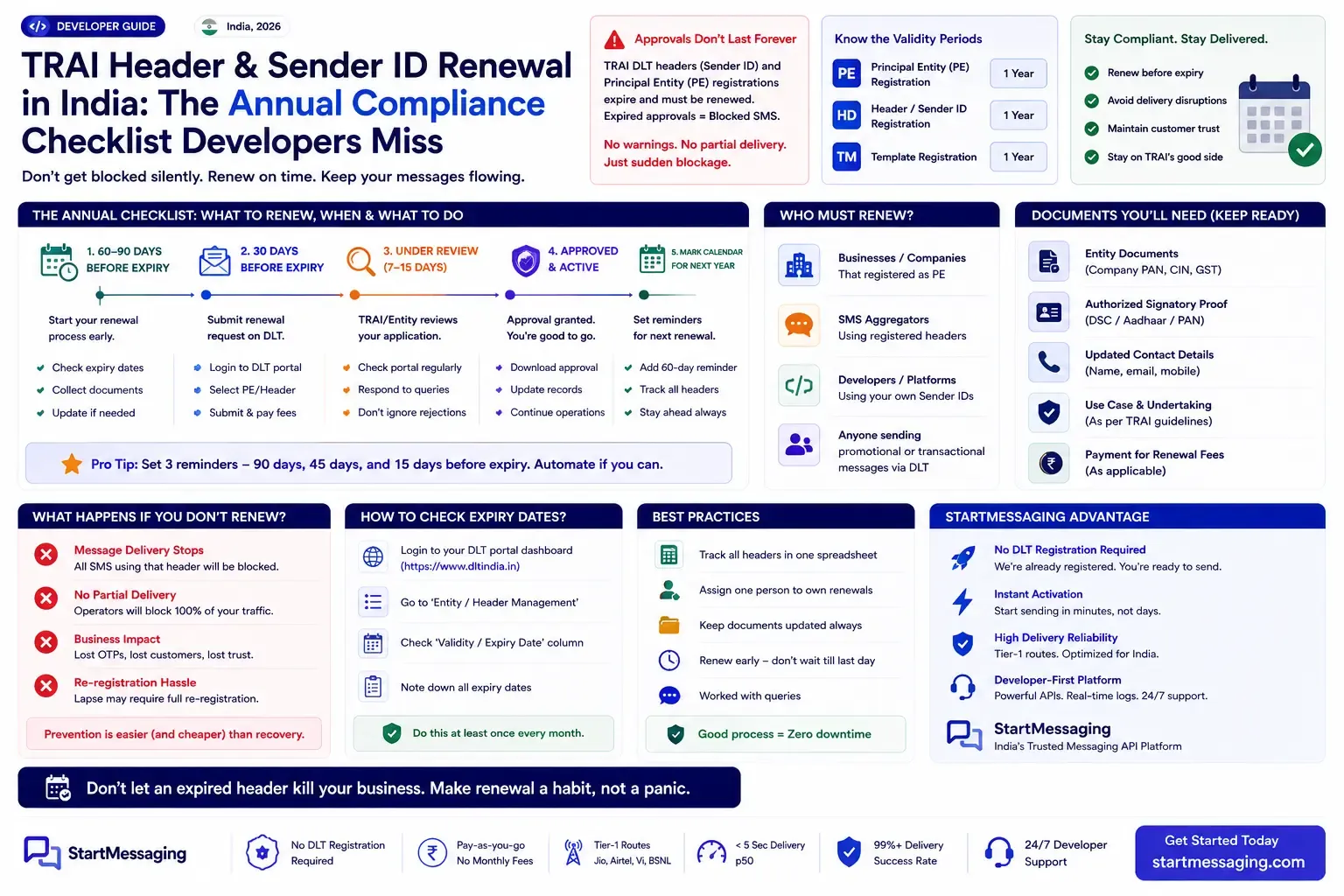
At 3:15 AM on a Tuesday, Karthik, principal backend architect at a Bengaluru healthtech platform, woke up to a barrage of high-severity PagerDuty alerts. Patient login OTP delivery rates across India had abruptly plunged from 98.4% to zero on Reliance Jio and Bharti Airtel networks. His team verified that their Node.js API endpoints were firing payload objects, the SMS aggregator gateway returned HTTP 200 OK, and third-party status monitors reported green. Yet, hundreds of user verification requests were vanishing into thin air. The culprit was not a server crash or a network outage—it was an expired DLT Sender ID (HLTAPP). His engineering team had spent weeks setting up initial DLT registration a year prior, but they missed the annual trai sender id header renewal india rules that silently block expired headers without emitting API error callbacks.
Understanding how TRAI header renewal rules operate independently from initial registration is essential for maintaining zero-downtime SMS operations in India. While most developers treat DLT registration as a one-and-done setup task, telecom operators systematically audit and revoke headers and Principal Entity (PE) accounts that miss their mandatory 12-month re-verification deadlines. This comprehensive guide breaks down TRAI’s annual header renewal lifecycle, details how network-level scrubbing drops lapsed messages, presents a step-by-step developer checklist for maintaining compliance, and explains how to eliminate renewal overhead entirely using pre-approved enterprise routing.
Why Initial DLT Registration Does Not Guarantee Permanent Sender ID Validity
Many engineering teams assume that once a business completes its initial Distributed Ledger Technology (DLT) onboarding, its messaging infrastructure remains active indefinitely. Under the Telecom Commercial Communications Customer Preference Regulations (TCCCPR) governed by TRAI, initial registration merely grants temporary authorization to send commercial communications across Indian telecom networks.
A Sender ID (or Header)—the 6-character alphanumeric code displayed as the sender name on mobile devices (e.g., STARTM or HLTAPP)—is tied to an annual validity cycle. Telecom operators enforce this restriction to prevent header squatting, identity spoofing, and orphaned sender tags from inactive companies.
┌───────────────────────────────────────────────────────────────────────────────────┐
│                              DLT Lifecycle Timeline                               │
├───────────────────┬───────────────────────────────────┬───────────────────────────┤
│ Month 0           │ Months 1–11                       │ Month 12                  │
│ Initial PE &      │ Active SMS Traffic                │ Annual Renewal Window     │
│ Header Approval   │ Normal Scrubbing & Delivery       │ Re-KYC & Fee Verification │
└───────────────────┴───────────────────────────────────┴───────────────────────────┘
The Difference Between PE Onboarding and Header Renewal
Initial registration validates your organization’s corporate identity (using business PAN, GSTIN, and incorporation certificates) and issues a 15-digit Principal Entity ID (PE-ID). In contrast, annual header renewal verifies that your organization actively maintains ownership of registered sender names and continues to comply with updated regulatory guidelines.
| Compliance Attribute | Initial DLT Onboarding | Annual Header & PE Renewal |
|---|---|---|
| Primary Goal | Business identity verification & PE-ID issuance | Re-verification of active header ownership & KYC |
| Validity Period | Permanent PE-ID (subject to annual KYC refresh) | 12 months (365 days) from approval date |
| Carrier Action on Failure | Complete inability to send SMS | Silent carrier scrubbing & message dropping |
| Operational Impact | Delayed product launch | Sudden production outage & broken login flows |
| Re-verification Scope | PAN, GSTIN, Board Resolution, Signatory ID | Fresh GST returns, active header usage, renewal fee |
Why Headers Expire Silently
Unlike domain name registries or cloud SSL certificates that send multiple automated renewal notices, Indian telecom DLT portals (Jio Trueconnect, Airtel DLT, Vi, and BSNL) rarely dispatch automated email reminders to engineering teams when a header approaches expiration.
If the primary administrative contact who created the DLT portal account leaves your company or misses a portal notification, your registered Sender IDs lapse without warning. When Karthik’s healthtech app hit the 365-day mark after registration, Airtel and Jio automatically shifted HLTAPP to EXPIRED_LAPSED status inside the central DLT ledger, triggering instant packet drops at the network switch layer.
The Mechanics of Silent Expiry: How Operators Scrub Lapsed Headers
To understand why traditional logging fails to capture expired header drop-offs, developers must examine how message scrubbing operates across telecom switches in India.
When your application initiates an SMS API call, your SMS aggregator receives the HTTP request and validates API keys, payload parameters, and account balance before generating an upstream gateway submission. However, real-time DLT compliance checks occur downstream at the Telecom Service Provider (TSP) level.
[Your App Backend] ──> [SMS Gateway] ──(HTTP 200)──> [Carrier SMSC Switch]
                                                            │
                                             ┌──────────────┴──────────────┐
                                             │ Query Shared DLT Ledger     │
                                             │ Check: PE-ID & Header State │
                                             └──────────────┬──────────────┘
                                                            │
                                       ┌────────────────────┴────────────────────┐
                                       ▼                                         ▼
                               [Header: ACTIVE]                          [Header: EXPIRED]
                                       │                                         │
                         (Delivered to Mobile Device)              (Packet Dropped Silently)
The Gateway Response Illusion
When an SMS API call is executed using an expired header, the upstream aggregator gateway receives your request, constructs the SMS PDU (Protocol Data Unit), and submits it to carrier SMSCs (Short Message Service Centers). Because the aggregator’s HTTP endpoint accepts the request, your backend receives a standard 200 OK response with a unique message identifier.
The carrier switch then queries the shared blockchain DLT ledger. If the ledger returns a status of EXPIRED or SUSPENDED for the Sender ID:
- The carrier SMSC drops the SMS packet immediately.
- No handset delivery attempt is made.
- The carrier does not return a negative delivery receipt (DLR) to the aggregator in many legacy routing configurations.
- Your application logs reflect a false positive where messages appear “Sent” or “Submitted”, but zero end-users receive authentication codes.
Multi-Carrier Ledger Synchronization Delays
A recurring issue developers face during header renewal is non-uniform synchronization across Indian carriers. India’s DLT architecture relies on a distributed ledger shared between Jio, Airtel, Vodafone Idea, and BSNL.
When you submit a renewal request on your primary registrar portal (e.g., Jio Trueconnect), the approval updates Jio’s node within 24 hours. However, propagation to secondary nodes (Airtel and Vi) can take an additional 24 to 72 hours. During this propagation window, users on Airtel network may experience complete delivery blocks while Jio users receive messages normally.
The Annual TRAI Header Renewal Checklist for Engineering Teams
To prevent unexpected delivery outages caused by expired DLT credentials, engineering leads and DevOps teams should execute this annual checklist 30 days prior to their registration anniversary.
1. Audit Active Sender IDs Across All Operator Portals
Log into your primary DLT portal (Jio Trueconnect, Airtel DLT, Vodafone Idea DLT, or BSNL DLT) and extract a full report of all registered 6-character headers. Categorize headers into:
- Production Active: Headers actively used in application code (e.g.,
STARTM,APPOTP). - Dormant: Headers registered for past marketing campaigns or deprecated products.
- Pending Renewal: Headers within 45 days of their 12-month expiration date.
2. Prepare and Submit Mandatory Annual Re-KYC Documents
Telecom operators require updated documentation to confirm that your organization remains active and legally compliant. Prepare the following digital assets before initiating renewal:
- Updated GST Registration Certificate: Showing active tax status for the current financial year.
- Company PAN Card: Verified copy matching company registration records.
- Letter of Authorization (LOA): Printed on official company letterhead, authorizing the designated administrator to manage DLT operations.
- Proof of Business Address: Recent utility bill or bank statement (issued within the last 3 months).
3. De-register Unused Headers to Prevent Dormancy Penalties
TRAI guidelines require operators to purge dormant headers that have recorded zero traffic over a rolling 6-month period. Retaining unused headers increases compliance audit scrutiny. Purge deprecated sender tags directly from your DLT portal to maintain a clean regulatory profile.
4. Verify Header-to-Template Association Integrity
Renewing a Sender ID does not automatically guarantee that associated content templates remain linked. Re-examine your approved SMS templates (such as login OTPs, transaction alerts, and password reset formats) to verify that every template ID remains explicitly mapped to your renewed 6-character header.
// Example: Verifying local DLT configuration mapping before deployment
interface DLTConfig {
  peId: string;
  header: string;
  templateId: string;
  headerExpiryDate: Date;
}

const productionDLTConfig: DLTConfig = {
  peId: "1701159820000012345",
  header: "STARTM",
  templateId: "1707161900000098765",
  headerExpiryDate: new Date("2026-11-30"),
};

function checkHeaderRenewalStatus(config: DLTConfig): void {
  const now = new Date();
  const daysRemaining = Math.ceil((config.headerExpiryDate.getTime() - now.getTime()) / (1000 * 60 * 60 * 24));

  if (daysRemaining <= 0) {
    console.error(`CRITICAL: Sender ID ${config.header} has EXPIRED. SMS delivery will fail.`);
  } else if (daysRemaining <= 30) {
    console.warn(`WARNING: Sender ID ${config.header} expires in ${daysRemaining} days. Initiate TRAI renewal.`);
  } else {
    console.log(`SUCCESS: Sender ID ${config.header} is valid for ${daysRemaining} days.`);
  }
}

checkHeaderRenewalStatus(productionDLTConfig);
The script above provides a defensive engineering practice: embedding automated expiry assertions into your CI/CD deployment pipeline or operational health checks ensures your team is alerted long before a header reaches its expiration deadline.
Automated Expiry Monitoring vs Bypassing Header Maintenance Entirely
Managing annual TRAI compliance requires ongoing administrative overhead, dedicated DevOps cycles, and tracking across fragmented carrier portals. Engineering teams have two primary paths for mitigating renewal risk.
                                  ┌──────────────────────────────────────────────┐
                                  │       Choose Your Compliance Strategy        │
                                  └──────────────────────┬───────────────────────┘
                                                         │
                        ┌────────────────────────────────┴────────────────────────────────┐
                        ▼                                                                 ▼
      ┌────────────────────────────────────┐                            ┌────────────────────────────────────┐
      │ Path A: Manual DLT Renewal         │                            │ Path B: Pre-Compliant OTP API      │
      ├────────────────────────────────────┤                            ├────────────────────────────────────┤
      │ • Track 365-day expiry dates       │                            │ • Zero DLT portal management       │
      │ • Re-upload GST & PAN annual docs  │                            │ • Enterprise pre-approved headers  │
      │ • Pay annual maintenance fees      │                            │ • Guaranteed delivery SLA          │
      │ • Handle multi-carrier sync delays │                            │ • Flat ₹0.25/OTP pricing           │
      └────────────────────────────────────┘                            └────────────────────────────────────┘
Implementing Real-Time Delivery Anomaly Detection
If your organization manages its own DLT registration, relying solely on portal renewal dates is insufficient. Implement real-time delivery rate anomaly alerts within your monitoring stack (such as Datadog, Grafana, or Prometheus):
- Calculate Delivery Rate Moving Averages: Track the percentage of delivered SMS messages relative to submitted requests over a rolling 15-minute window.
- Set Carrier-Specific Triggers: If delivery rates drop by more than 15% on a specific mobile operator (e.g., Jio or Airtel) while remaining normal on others, trigger an immediate alert for potential header ledger desynchronization.
- Automate Fallback Channels: Configure automatic fallback to alternative authentication methods (such as WhatsApp OTP or Email) when SMS delivery rates fall below 80%.
Bypassing Renewal Overhead with StartMessaging DLT-Free OTP
For startups, scale-ups, and developers who want to avoid the administrative burden of annual DLT renewals, managing individual corporate headers is often an unnecessary operational drag.
StartMessaging provides a developer-first authentication infrastructure that routes SMS verification traffic through pre-approved, enterprise-grade headers maintained under StartMessaging’s corporate DLT infrastructure.
- Zero DLT Portal Administration: Skip annual document uploads, portal navigation, and carrier re-verification queues.
- Zero Expiry Risk: Production delivery relies on continuously maintained, high-throughput enterprise headers monitored 24/7.
- Instant Setup: Integrate via a single REST API call using client SDKs for Node.js, Python, PHP, or Go.
- Predictable Pricing: Pay a flat rate of ₹0.25 per successful OTP without annual portal maintenance fees or recurring registration costs.
Frequently Asked Questions
Q: Do TRAI Sender IDs (Headers) expire automatically every year?
A: Yes. Under TRAI DLT regulations in India, registered 6-character Sender IDs (Headers) carry a 12-month validity period. Principal Entities must submit updated annual re-KYC documents and pay any applicable portal maintenance fees through their primary telecom operator portal to maintain active header status.
Q: Why does my SMS API return a success status even if my DLT header is expired?
A: Upstream SMS gateway APIs validate your account credentials and payload formatting before forwarding messages to telecom networks. The DLT compliance check occurs downstream at the carrier switch layer. If your header is expired, the carrier switch drops the message silently without returning an immediate synchronous error to the originating gateway API.
Q: What documents are required for annual DLT header renewal in India?
A: Operators require an updated GST registration certificate for the current financial year, company PAN verification, proof of active corporate address, and a fresh Letter of Authorization (LOA) printed on company letterhead and signed by an authorized signatory.
Q: How long does DLT header renewal take to propagate across all Indian operators?
A: Portal approval by your primary carrier (e.g., Jio or Airtel) typically takes 24 to 48 hours. However, cross-operator ledger synchronization to secondary carrier nodes (Vi and BSNL) can require an additional 24 to 72 hours, during which delivery performance may vary across networks.
Q: Can I send OTPs in India without worrying about annual header renewals?
A: Yes. By integrating StartMessaging’s DLT-free OTP API, your authentication messages are transmitted using StartMessaging’s pre-approved enterprise DLT headers. This eliminates the need for initial business DLT registration, template approvals, and annual header renewal checks.
After spending 36 stressful hours uploading fresh GST filings and waiting for DLT ledger synchronization across Airtel and Jio, Karthik’s healthtech platform restored its delivery rates to normal. To eliminate future compliance risks and annual maintenance headaches, his engineering team migrated their core authentication pipeline to StartMessaging. If you want to bypass DLT portal friction, eliminate annual header renewals, and ensure reliable message delivery across all Indian networks, explore StartMessaging’s OTP API today — start sending SMS verification codes in minutes at ₹0.25 per OTP with your first 100 messages free.
StartMessaging Team
StartMessaging Team