WhatsApp AI Provider Pricing: Meta's 2026 Policy Explained
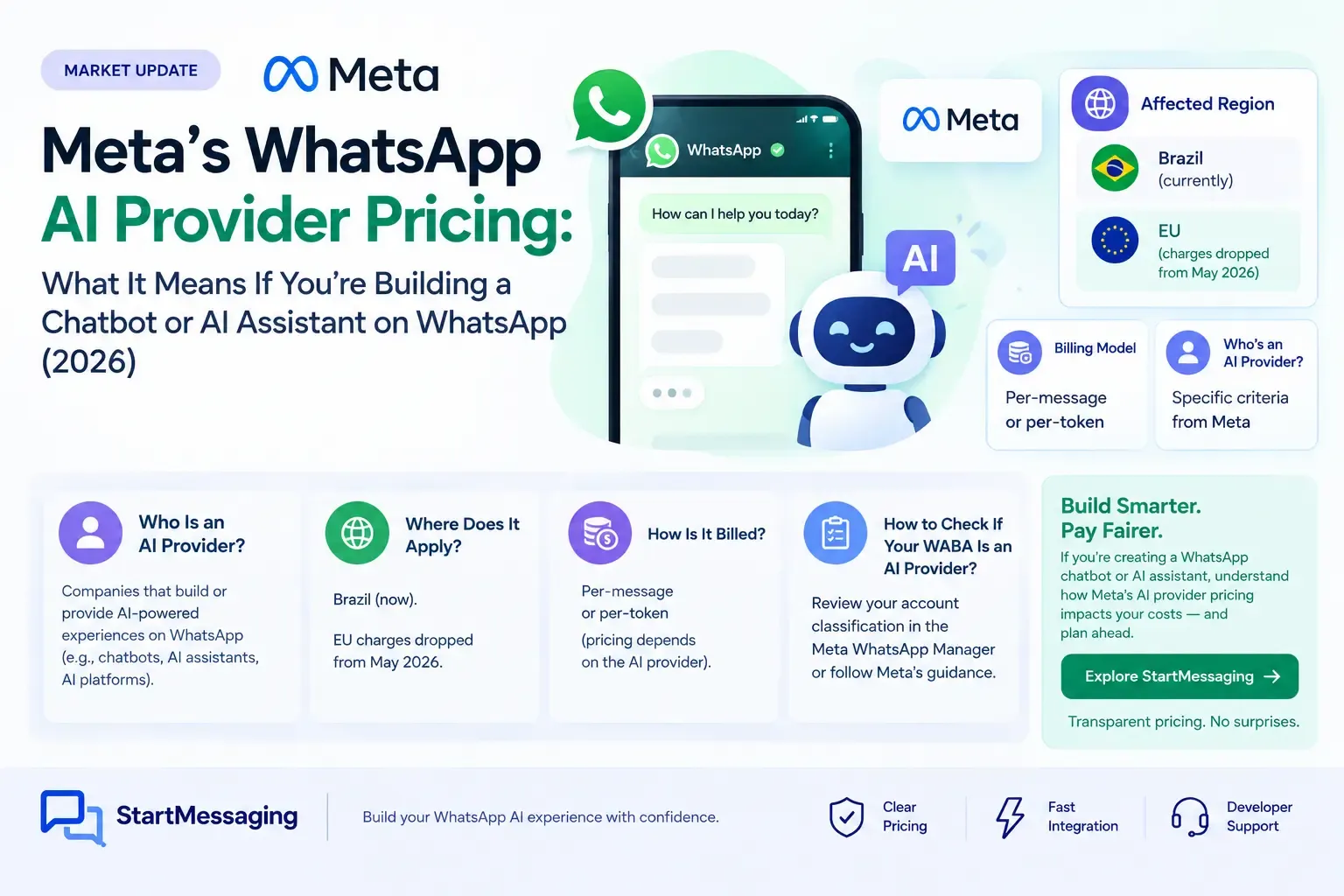
Meta's WhatsApp AI Provider pricing explained: who counts as an AI Provider, which markets are charged, and how to check if your WABA is classified as one.
Karthik builds conversational AI for a Bengaluru startup whose largest customer is a retailer in São Paulo. In March his customer forwarded a Meta invoice with a line item nobody on either team recognised — non-template messages, billed, on an account where non-template replies had always been free. It took two days to work out that Meta had classified the WABA as an AI Provider, and that WhatsApp AI Provider pricing is a completely separate policy from the one everybody had been reading about. Understanding it matters if you build chatbots, run a BSP, or sell an AI assistant that talks to users on WhatsApp.
The confusion is understandable. Meta shipped three distinct AI-related billing and policy changes in eighteen months, they use overlapping vocabulary, and only one of them has anything to do with most Indian developers. This post separates them, then shows you the two API fields that tell you definitively which bucket your account sits in.
Three Policies That Keep Getting Conflated
Before anything else, get these straight. They are separate, they have different dates, and they apply to different people.
| Policy | Effective | Who it hits | How it bills |
|---|---|---|---|
| AI Provider ban (Business Solution Terms) | 15 Oct 2025 new accounts, 15 Jan 2026 existing | General-purpose AI assistants distributed via the API | Not billing — prohibition |
| AI Provider pricing | 16 Feb 2026, updated 12 May 2026 | AI Providers in markets where Meta must legally permit them | Per non-template message |
| Meta Business Agent | 1 Aug 2026 | Anyone using Meta’s own AI agent product | Per token, $2.00 per 1M tokens |
A fourth change sits alongside these and applies to everyone regardless of AI: from 1 October 2026, service messages and in-window utility templates became billable for all businesses. That one is covered in our October 2026 pricing change guide and is not an AI policy at all, though it is routinely reported as though it were.
Who Meta Counts as an “AI Provider”
Meta’s definition is broad, and it is worth reading in the original rather than in paraphrase. An AI Provider is:
“Providers and developers of artificial intelligence or machine learning technologies, such as large language models, generative artificial intelligence platforms, general-purpose artificial intelligence assistants, or similar technologies who provide certain services on WhatsApp Business Platform.”
The prohibition in the WhatsApp Business Solution Terms is narrower than that definition, and the narrowing is the whole ballgame. AI Providers are barred from using the platform “for the purposes of providing, delivering, offering, selling, or otherwise making available such technologies when such technologies are the primary (rather than incidental or ancillary) functionality.”
Primary versus incidental is the test that decides everything
Read that clause carefully, because it is the line your product sits on one side or the other of.
If the AI is the product — an open-ended assistant a user talks to about anything, reached through a WhatsApp number — you are an AI Provider and you are prohibited. ChatGPT, Copilot, Perplexity, Luzia and Poke all exited WhatsApp on this basis; Microsoft confirmed Copilot’s discontinuation and OpenAI published migration guidance for users.
If the AI is how a business handles its own customers — order status, support triage, appointment booking, FAQ answering, login codes — it is ancillary to a business workflow and is explicitly permitted. Meta has been clear that structured, task-specific automation is not only allowed but is the intended use of the platform. A Meta spokesperson put the reasoning plainly: “The purpose of the WhatsApp Business API is to help businesses provide customer support and send relevant updates.”
The practical test: could a user ask your bot to write a poem and get one? If yes, you have a classification problem. If your bot answers “where is my order” and politely declines everything else, you do not.
What Meta says it is actually objecting to
Meta’s stated reason is load, not ideology. General-purpose assistants generated message volume and support demand that fell outside “the intended design and strategic focus” of the API — a platform built for a business to talk to its own customers being used as a distribution channel for consumer AI products. Whatever you make of that, it explains why the line is drawn at primary-versus-ancillary rather than at whether AI is involved at all.
Where AI Provider Charges Apply — and Where They Stopped
This is the part almost nobody gets right, because the answer changed twice in three months.
Meta only charges AI Providers in markets where it is legally required to permit them in the first place. Everywhere else, general-purpose AI assistants are simply banned, so there is nothing to price. Meta’s own framing: AI Providers are permitted “only where Meta is legally required to permit this use case,” and in those markets Meta charges for each non-template message delivered to a user.
| Market | Charged from | Charged until |
|---|---|---|
| Italy (+39) | 16 Feb 2026 | 12 May 2026 |
| Austria, Belgium, Bulgaria, Croatia, Cyprus, Czech Republic, Denmark, Estonia, Finland, France, Germany, Greece, Hungary, Iceland, Ireland, Latvia, Liechtenstein, Lithuania, Luxembourg, Malta, Netherlands, Norway, Poland, Portugal, Romania, Slovakia, Slovenia, Spain, Sweden | 11 Mar 2026 | 12 May 2026 |
| Brazil (+55) | 11 Mar 2026 | Still in effect |
European charges were suspended as of 13 May 2026, at midnight in each WABA’s local timezone. Brazil is currently the only market where AI Provider charges are live. That is why Karthik’s São Paulo customer saw the line item and his Indian and European customers did not.
Two notes on the rates themselves. Meta publishes AI Provider rates as separate CSV and PDF rate cards linked from the AI Providers pricing documentation, rather than inline on the page, and the doc states these rates “are specific to AI Providers using the WhatsApp Business Platform” — they are not the standard utility or service rates. There is also a separate card for rates effective 1 July 2026. Pull the current CSV rather than relying on any figure quoted in a blog post, this one included, because the page was last revised on 12 May 2026 and the market list has already moved once.
The other honest gap: Meta’s AI Provider page does not address how these charges interact with the 1 October 2026 change that made non-template service messages billable for every business. If you run AI Provider traffic into Brazil, ask your BSP which rate is being applied to your non-template messages from October onward rather than assuming the two policies merged.
How to Check Whether Your WABA Is Classified as an AI Provider
You do not have to guess, and you should not rely on your BSP’s account manager. Meta exposes the classification in two places, and both return it as data you can query or log.
The Pricing Analytics API returns pricing_category: "AI_BOT"
Pull a pricing analytics breakdown for your WABA over a period you have already been billed for. AI Provider traffic comes back tagged with its own pricing category, distinct from MARKETING, UTILITY, AUTHENTICATION and SERVICE:
{
  "start": <START_TIMESTAMP>,
  "end": <END_TIMESTAMP>,
  "phone_number": "<BUSINESS_PHONE_NUMBER>",
  "country": "<COUNTRY_CODE>",
  "pricing_type": "REGULAR",
  "pricing_category": "AI_BOT",
  "volume": <VOLUME>,
  "cost": <COST>
}
If any row in your analytics response carries pricing_category of AI_BOT, Meta is treating that traffic as AI Provider traffic. If every row comes back as one of the four standard categories, it is not. The volume and cost fields on that row tell you exactly what the classification has cost you, which is the number to take into any conversation with Meta or your provider.
Message status webhooks carry category: "general_purpose_ai"
The same classification appears per message, in real time, in the pricing object on message status webhooks:
"pricing": {
 "billable": true,
 "pricing_model": "PMP",
 "type": "regular",
 "category": "general_purpose_ai"
}
Log this object on every status callback — it is worth doing regardless of AI classification, because the same category field is what tells you which rate was applied to any message. A category of general_purpose_ai on a non-template message means that message was billed under the AI Provider policy. If you are not capturing status webhooks at all yet, our webhooks documentation covers the setup.
Checking both is worth the effort: analytics gives you the historical and financial picture, webhooks give you the per-message signal that catches a reclassification the week it happens rather than the month you get the invoice.
What This Means If You Build WhatsApp Bots From India
For most Indian developers reading this, the practical answer is short: AI Provider pricing does not apply to you, and it probably never will.
India (+91) has never appeared on Meta’s charged-markets list. Meta charges AI Providers only where it is legally compelled to allow them, and in India — as in most of the world — general-purpose AI assistants are simply prohibited on the platform. There is no rate to pay because there is no permitted use case to price. If you are building task-specific business chatbots for Indian customers, you are outside both the ban and the pricing policy, and your bot’s replies are billed as ordinary service messages at ₹0.1150 under the standard India rate card.
Three situations do warrant attention.
- You sell a chatbot platform to customers outside India. If any of your customers deliver non-template messages to Brazilian numbers and your product could be read as a general-purpose assistant, the classification risk is theirs and the invoice surprise is yours to explain. Check
pricing_categoryacross your customer WABAs before they check it for you. - Your bot’s scope has drifted. Products that started as order-status bots and grew an open-ended “ask me anything” mode have moved across the primary-versus-ancillary line without anyone deciding to. Scope the model’s refusal behaviour deliberately, not by accident.
- You are weighing Meta Business Agent. That is a different product with a different bill — $2.00 per million tokens, roughly $0.04–$0.05 per reply, against ₹0.1150 for a service message sent by your own bot. In India that gap is roughly 30–40× per reply, which we work through in our WhatsApp cost reduction guide.
Frequently Asked Questions
Q: Is my WhatsApp chatbot banned under Meta’s AI Provider policy?
A: Only if the AI itself is the product. The Business Solution Terms prohibit AI Providers from using the platform where the AI technology is “the primary (rather than incidental or ancillary) functionality.” A bot that handles order status, support triage, bookings, FAQs or authentication for a specific business is explicitly permitted. An open-ended assistant a user converses with about anything is not. The rule applied to new accounts from 15 October 2025 and to existing accounts from 15 January 2026.
Q: Which countries have WhatsApp AI Provider charges right now?
A: Brazil only. Italy was charged from 16 February to 12 May 2026, and 29 other European markets from 11 March to 12 May 2026, with all European charges suspended as of 13 May 2026. Brazil’s charges started on 11 March 2026 and remain in effect. India has never been on the list.
Q: How do I check if Meta has classified my WABA as an AI Provider?
A: Two places. In the Pricing Analytics API, look for rows returning pricing_category of AI_BOT rather than the standard marketing, utility, authentication or service categories. In message status webhooks, check the pricing object for category set to general_purpose_ai. Either value means Meta billed that traffic under the AI Provider policy.
Q: What is the difference between AI Provider pricing and Meta Business Agent pricing?
A: They are unrelated. AI Provider pricing charges third-party AI companies per non-template message, in the handful of markets where Meta is legally required to permit general-purpose assistants. Meta Business Agent is Meta’s own AI agent product, available since 3 June 2026 and billed per token at $2.00 per million tokens from 1 August 2026. Your own bot or your BSP’s AI is neither — its replies bill as ordinary service messages.
Q: Does AI Provider pricing affect Indian businesses using WhatsApp chatbots?
A: No. India has never been a charged market, and general-purpose AI assistants are prohibited on the platform in India rather than priced. Indian businesses running task-specific automation pay standard service message rates — ₹0.1150 per message after the first 1,000 per business phone number per month, plus 18% GST.
Karthik’s São Paulo problem turned out to be narrow. One customer, one market, one classification, visible in a single analytics field he now logs across every account he operates. The two days went into working out which of three similarly-named policies he was actually looking at — which is the part worth not repeating.
If you are building on WhatsApp from India, the classification questions above are usually answered in a few minutes of API calls, and the pricing that follows is the ordinary India rate card rather than anything exotic. StartMessaging passes Meta’s per-message rates through at cost, and the complete WhatsApp Business API guide covers the platform end to end. WhatsApp onboarding for Indian businesses is currently sales-assisted while we finalise self-serve provisioning — if you are building a chatbot product and want a second opinion on where your use case sits against Meta’s terms before you commit engineering to it, talk to our team.
StartMessaging Team
StartMessaging Team